
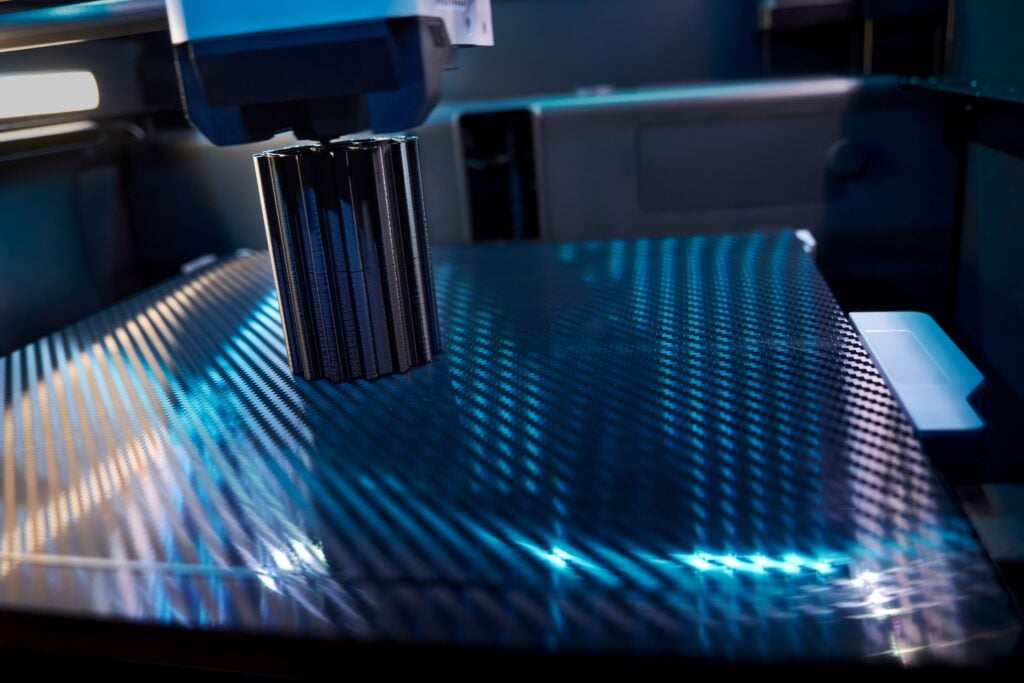
As one element of the digital age, 3-D printing, or rapid prototyping as it was originally known, is a relatively ‘new’ addition with its origins dating back to the 1980s. In fact, it was in 1981 in Japan that Dr Hideo Kodama invented the very first rapid prototyping machine which involved the creating of parts using a layering process with the resin being polymerised using UV light. Five years later in 1986, Chuck Hull filed the first patent for stereolithography (SLA) and it is he who became known as the ‘father of printing’ through his creation and commercialisation of both SLA and, as important, the .stl format.
In 1988, Carl Deckard, who at the time was a student at the University of Texas, licensed selective laser sintering (SLS) technology, which was an additional form of 3-D printing that used a laser to sinter (fuse together using heat but without melting the materials) powdered material into solid structures. The following year, Scott Crump patented fused deposition modelling (FDM) – a.k.a. fused filament fabrication (FFF) – and founded Stratasys, one of the main players in the 3-D printing industry. However, it wasn’t until 2006 that the first commercially available 3-D printer hit the market.
Thanks to the RepRap Project, founded by Dr Adrian Bower, 2005 proved to be a very important year in the history of 3-D printing. The RepRap Project was an open-source initiative and, according to UltiMaker, the initial goal of the project was to re-think additive manufacturing, starting with FDM/FFF, as a low-cost technology capable of self-replication. The result was a 3-D printer called the RepRap, which became an inspiration for virtually every successful low-cost 3-D printer from that point on. The RepRap 3-D printer comprised many plastic parts that could be printed by the RepRap itself, meaning that it was “self-replicating”.
Jumping forward to today, and not only do they have a low-gravity 3-D printer on the International Space Station to print tools on an as-and-when-needed basis, but you also have companies such as Gerhard Schubert who have created a ‘digital warehouse’ of parts and tools that can be printed to order both for customers and other organisations. Now you will find frequent examples of 3-D printed elements and parts in the automotive, construction, healthcare, manufacturing and, of course, aerospace industries.
In fact, additive manufacturing (3-D printing) is increasingly reshaping the aerospace industry. While the technology was initially used for rapid prototyping, it has evolved into a powerful production method capable of manufacturing certified aircraft components. In the context of aircraft maintenance, repair, and overhaul (MRO), additive manufacturing now offers new possibilities for producing spare parts more efficiently, both reducing supply chain complexity and enabling innovative design solutions.
As airlines operate increasingly complex aircraft and global fleets continue to age, when combined with supply chain problems, the need for reliable spare parts has never been greater. Traditional manufacturing methods often require long lead times and large inventories of rarely used components. Additive manufacturing addresses many of these challenges by enabling on-demand production of parts directly from digital models, making it a compelling solution for modern maintenance operations.
Understanding Additive Manufacturing in Aviation
Additive manufacturing differs fundamentally from conventional manufacturing techniques as traditional production methods typically involve subtractive processes such as machining, where material is removed from a solid block. In contrast, additive manufacturing builds components layer by layer, depositing or fusing material according to a digital design file.
Several additive manufacturing processes are widely used in aerospace applications. One of the most common is Powder Bed Fusion (PBF), which includes technologies such as Selective Laser Melting (SLM) and Electron Beam Melting (EBM). In these systems, a high-energy laser or electron beam melts layers of metallic powder—often titanium, aluminium, or nickel alloys—to form strong and precise components.
Another important method is Directed Energy Deposition (DED). This technique feeds metal powder or wire into a focused energy source that melts the material as it is deposited. DED is particularly valuable for repairing worn components or adding material to existing parts.
A third approach, Binder Jetting, uses a liquid binding agent to join layers of powdered material before the part is sintered in a furnace. The advantages of binder jetting is that it offers high production speed and is increasingly considered for manufacturing non-critical aircraft components.
Advantages for Aircraft Spare Parts Production
One of the most significant benefits of additive manufacturing in aviation is the ability to produce spare parts on demand. Aircraft maintenance organisations must traditionally maintain large inventories of parts to support fleets that may remain in service for several decades. Many of these components are rarely needed but must still be available when required.
With additive manufacturing, maintenance providers can store digital design files instead of physical inventory, so when a part is needed, it can be produced locally using certified printing systems. This approach can dramatically reduce storage requirements and shorten delivery times, particularly during aircraft-on-ground (AOG) situations where rapid replacement of a part or parts is critical. Another key advantage is reduced manufacturing lead time as conventional aerospace components often require specialised tooling and multiple machining steps. Additive manufacturing eliminates many of these processes, allowing parts to be produced more quickly and with fewer intermediate steps.
The technology also enables advanced design optimisation. Engineers can create complex geometries that would be difficult or impossible to produce using traditional manufacturing techniques. Methods such as topology optimisation allow designers to remove unnecessary material while maintaining structural strength. As a result, printed components can be significantly lighter than conventionally manufactured equivalents—an important factor in reducing aircraft fuel consumption.
Applications in Maintenance, Repair, and Overhaul
Additive manufacturing is already being used in several areas of aircraft maintenance. One of the most common applications is the production of cabin interior components, which generally face fewer certification barriers than structural parts. Items such as air ducts, seat components, brackets, and interior fittings can often be printed quickly and installed during routine maintenance.
Maintenance facilities are also using additive manufacturing to produce custom tooling and equipment. Technicians frequently require specialised fixtures, inspection gauges, or protective covers that are difficult to source through traditional channels. With 3-D printing, these tools can be designed and manufactured internally, allowing maintenance teams to respond quickly to operational needs.
In more advanced applications, additive manufacturing is being used for engine and structural components. Certain brackets, heat exchangers, and turbine parts are already produced using additive manufacturing processes. These parts benefit from the high strength and temperature resistance of aerospace-grade materials such as titanium alloys and nickel-based superalloys.
Certification and Regulatory Requirements
Despite its advantages, additive manufacturing must meet the strict safety standards required for aviation. Any aircraft component must comply with regulations set by authorities such as the European Union Aviation Safety Agency (EASA) and the Federal Aviation Administration (FAA).
Certification of additively manufactured parts involves extensive testing and process validation where regulators must ensure that printed components possess consistent material properties and structural integrity. This requires careful control of the manufacturing process, including powder quality, printing parameters, and post-processing procedures.
Traceability is another critical requirement as each component must be fully documented, including the digital design file, production parameters, and inspection results. Advanced quality control techniques—such as X-ray computed tomography and non-destructive testing—are often used to verify the internal structure of printed parts.
Toward a Digital Aviation Supply Chain
One of the most transformative aspects of additive manufacturing is its potential to create a digital supply chain where, instead of shipping physical spare parts around the world, manufacturers can distribute secure digital files that authorised facilities can use to produce components locally. This concept enables distributed manufacturing, where certified maintenance hubs or airports operate additive manufacturing systems capable of producing approved spare parts on demand. Such a model can significantly reduce transportation costs and improve the resilience of the aviation supply chain.
However, this approach also introduces new challenges, particularly in the area of cybersecurity. Digital design files must be carefully protected to prevent unauthorised reproduction or tampering and thus secure data management and encryption technologies therefore play an increasingly important role in additive manufacturing ecosystems.
Challenges and Future Outlook
Although additive manufacturing has made significant progress, several challenges remain. For example, certification processes can be complex and time-consuming, especially for critical structural components. Production speed is another factor; while additive manufacturing excels at producing small batches or highly complex parts, traditional manufacturing methods may still be more efficient for high-volume production. Material availability also continues to expand, but the range of printable aerospace-approved materials remains narrower than that used in conventional manufacturing, though ongoing research aims to develop new alloys and improve printing technologies to mktigate these limitations.
Despite these challenges, the future of additive manufacturing in aircraft maintenance appears promising. Advances in printing technology, process monitoring, and materials science are steadily expanding the range of components that can be produced using additive methods. As regulatory frameworks evolve and industry experience grows, there is every likelihood that additive manufacturing will become an integral part of aircraft maintenance operations.
Conclusion
Additive manufacturing is transforming the way aircraft spare parts are designed, produced, and supplied. By enabling on-demand production, reducing lead times, and allowing innovative lightweight designs, 3-D printing offers substantial advantages for airlines and maintenance organisations.
While regulatory, technical, and operational challenges remain, the continued development of additive manufacturing technologies is paving the way for a more flexible and efficient aviation supply chain. In the coming years, digital inventories and distributed production networks may become standard practice, making additive manufacturing a cornerstone of modern aircraft maintenance.