

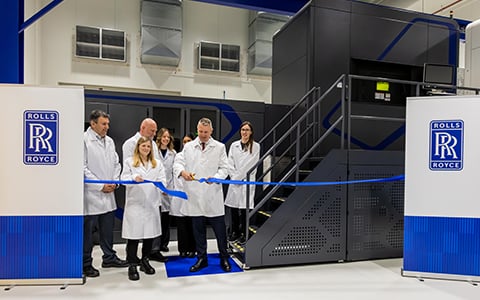
Rolls-Royce has opened a new Additive Manufacturing (AM) Development Cell at its Defence Assembly and Operations facility in Bristol, UK. Funded by the UK Ministry of Defence, the cell uses advanced additive manufacturing technology to produce critical components for next-generation aircraft engines. By integrating this German-engineered capability, the UK remains at the forefront of aerospace engineering, delivering complex parts with shorter lead times, lower costs and greater efficiency than traditional methods.
The machinery will play a key role in accelerating innovation, knowledge and skills across the Global Combat Air Programme (GCAP), as well as future combat air power and propulsion applications within Defence and across Rolls-Royce more broadly. Newly optimised, lightweight engine components will enable future aircraft to achieve greater power and improved fuel efficiency, delivered at pace. Engineers are being specially trained to operate the cell, supporting job creation and long-term capability at the Bristol hub, the UK’s centre for military combat and transport aerospace power and propulsion.
The facility is housed in a purpose-built, tightly controlled 350 m² environment, where humidity, temperature and air pressure are optimised to ensure consistent quality. The AM system produces aerospace components layer by layer using metal superalloy powders, precisely melting each layer with laser beams to create highly complex structures.
In addition to weight savings, components produced in the cell will enable faster delivery to partners and customers while improving cost efficiency. The precision of AM technology also enhances energy efficiency, using only the required amount of raw material, reducing waste and lowering the power needed for production.