
easyJet and Rolls-Royce have announced the successful completion of a major testing milestone using hydrogen as an aviation fuel, marking a significant step towards reducing aviation emissions.
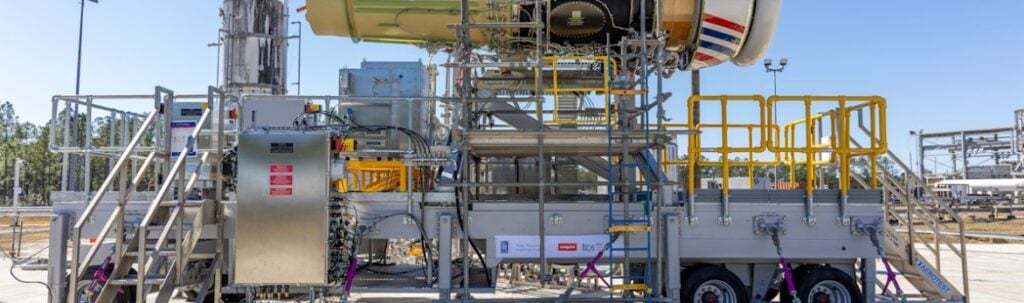
In an industry first, the companies tested a modified Rolls-Royce Pearl 15 aircraft engine at NASA’s Stennis Space Center near Bay St. Louis, Mississippi, achieving full take-off power while operating on 100% hydrogen.
This milestone is the result of a four-year programme involving Rolls-Royce, easyJet and global partners to explore hydrogen as a potential aviation fuel and to generate engineering insights for future propulsion applications. easyJet has played a central role in supporting the development of hydrogen gas turbine technology as part of its long-term decarbonisation strategy. Rolls-Royce’s expanded partnership with TCS has accelerated progress by adding capability and capacity across key engineering workstreams.
During this phase of testing, engineers demonstrated that a modern jet engine—scalable for a narrow-body aircraft—can safely operate on gaseous hydrogen across a fully simulated flight cycle, including start-up, take-off, cruise and landing.
The Rolls-Royce programme has followed an incremental, technology-led approach to validate core technologies. Beginning with initial engine tests at Boscombe Down in the UK in 2022, the programme progressed through a UK and European campaign of component and system rig testing, including the development of a full-scale hydrogen test facility at the Health and Safety Executive (HSE), before advancing to full integration within a hydrogen-fuelled demonstrator engine. Earlier modifications focused on adapting the engine to replace conventional jet fuel with hydrogen, while addressing both carbon and non-CO₂ impacts through an extensive combustion programme.
The programme has generated valuable insights into hydrogen combustion, fuel systems and engine integration, supporting the potential for future hydrogen-powered aircraft to significantly reduce carbon emissions across UK and European aviation. This approach is expected to complement Sustainable Aviation Fuel (SAF) in enabling future sector growth, as highlighted in the report Enabling Hydrogen in the European Aviation Market.