

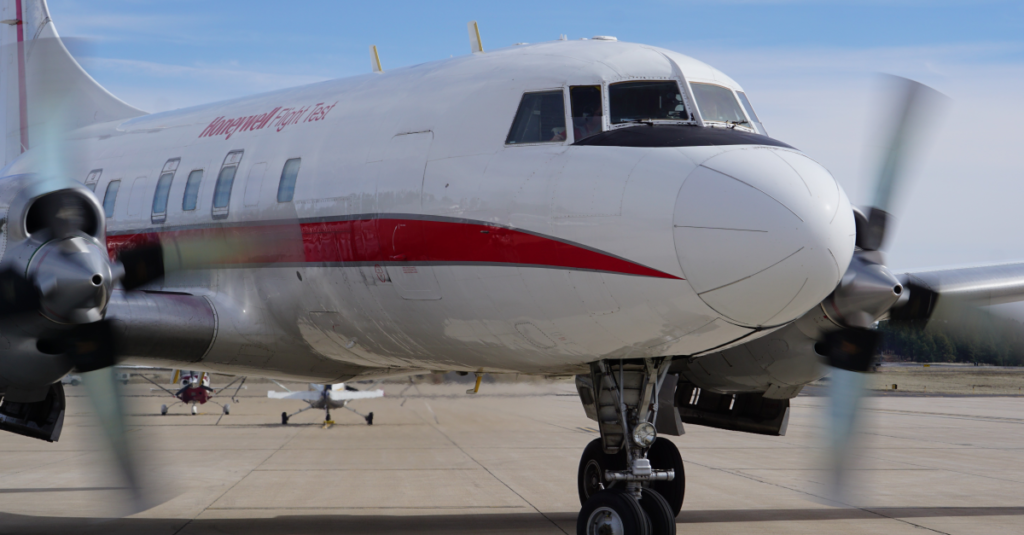
Honeywell has retired its Convair 580 test aircraft after 67 years of service in flight, leaving behind a legacy of testing and helping bring to market some of the most advanced safety features in modern aviation. AlliedSignal acquired the venerable aircraft in 1992, and when the company merged with Honeywell in 2000, it remained in the test fleet until its final flight a month ago.
In Honeywell’s flight test fleet, the Convair 580 was a workhorse in many areas because the aircraft’s design made it capable of holding gear usually meant for installation on larger commercial aircraft. Its traditional passenger interior was stripped to make room for multiple data centers and servers to record information collected during test flights. Honeywell engineers used the recorded data to create what are known today as the Enhanced Ground Proximity Warning System (EGPWS), the Traffic Alert and Collision Avoidance System, and the IntuVue RDR-4000 Weather Radar System.
To test the accuracy of IntuVue and other radar systems, test flights were performed during real-life and highly dangerous scenarios. During the summer months, pilots would test the IntuVue RDR-4000 Weather Radar System by flying the Convair under and directly into thunderstorms over the Everglades and off the coast of Florida. The IntuVue RDR-4000 Weather Radar System is the world’s first airborne 3D weather radar. It is fully automated, allowing pilots to focus more on detection and analysis versus controlling the radar manually.
In addition to flying through thunderstorms, Convair pilots would fly directly toward mountainous terrain to test that the warning signals in the EGPWS were activating when the aircraft was too close to dangerous terrain features. Once the aircraft was near, pilots would hear warning signals such as “PULL UP” and “TERRAIN.”
“You have to have confidence in your aircraft to be around mountains, thunderstorms, and volcanos, because you’re flying so close to terrain, you’ll experience a lot of turbulence. Thankfully, the Convair is a heavy-duty aircraft and has very reliable engines,” said Randy Moore, chief test pilot for Honeywell Aerospace who has flown the company’s 580 since 2004. “I always thought of it like a 1952 Chevy pickup. That’s what the Convair was like.”
There are estimated to be fewer than 100 Convairs left flying. This aircraft was initially certified on January 15, 1952, as a Convair 340, not a 580. It was first put into service by United Airlines on September 2 of that year, and it had an uneventful run until late 1964. On December 30, 1964, the jet experienced a forced landing after both engines stopped because of fuel starvation. The plane landed safely in a field in a small town northwest of Los Angeles, and none of the 43 passengers or crew on board were injured.