
A busy week at the 2024 Farnborough International Airshow marked key milestones for VoltAero and its Cassio electric-hybrid aircraft family. Highlights included a pre-order agreement with Global Sky, a collaboration on advanced air mobility solutions with Sigma Air Mobility, and the unveiling of propulsion partner Kawasaki Motors’ roadmap for its aero piston engine family.
Opening this week-long international event in the UK was a pre-order Memorandum of Understanding (MoU) announcement on Monday, July 22, for 15 Cassio aircraft with Singapore-based Global Sky, positioning the provider of aircraft trading services as a candidate launch customer in Southeast Asia.
The agreement also includes defining routes and operations for Cassio aircraft in Southeast Asia’s rapidly maturing regional aviation infrastructure, identifying airport compatibility, establishing recharging infrastructure, and developing a Cassio distribution network.
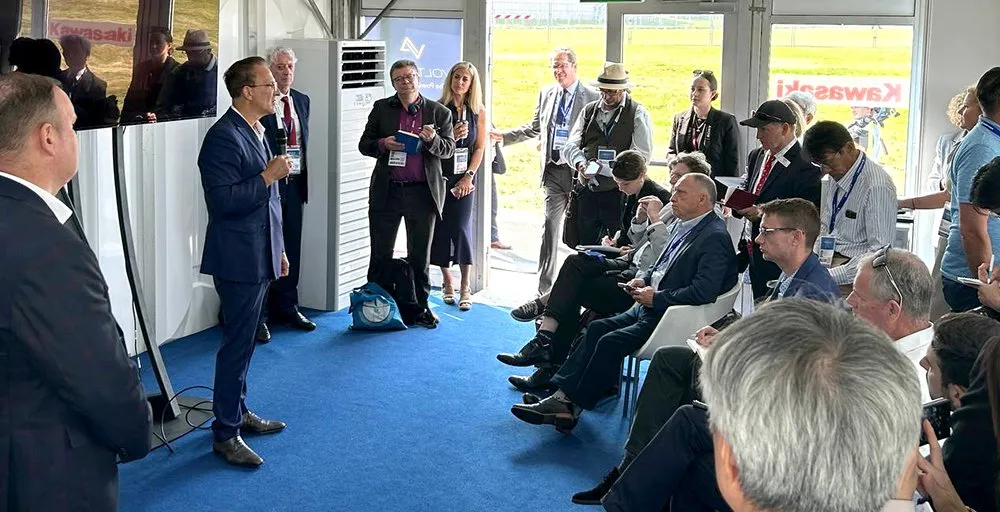
On Wednesday, a standing-room-only press conference at VoltAero’s Farnborough Airshow exhibit stand unveiled an MoU for the early development of advanced air mobility solutions with Sigma Air Mobility. This collaboration opens the potential for a route demonstration pilot in Europe and identifies services for Cassio in its air ambulance version.
The wide-ranging agreement brings VoltAero’s development of the Cassio airplane family and its unique parallel electric-hybrid propulsion system together with Sigma Air Mobility’s expertise as a network operator for a local, streamlined pilot project – with the route demonstration’s location to be announced later this year.
The MoU also identifies the joint opportunity to develop industry technical standards for airport recharging infrastructures and facilities, along with potential collaboration on operating models, economics, and decarbonisation trends and metrics to adjust growth plans and fleet deployment.
Another focus of the press conference was the roadmap outlined by VoltAero’s propulsion partner and strategic investor, Kawasaki Motors Ltd., for the Japanese company’s aero piston engine product line. VoltAero will integrate Kawasaki Motors’ aero piston engine in Cassio’s hybrid propulsion module together with an ENGINeUS electric motor from its industrial partner, Safran, to drive a single pusher propeller via a gearbox.
Hiroshi Ito, Kawasaki Motors’ President and CEO, said the company is continuing the development of its initial aero product – a four-cylinder piston engine – based on the company’s supercharged engine for Kawasaki’s iconic Ninja H2®R high-power motorcycle. Kawasaki Motors is also developing a 2.1-litre, six-cylinder aero engine capable of operating on sustainable aviation fuels, e-fuels, and hydrogen.
Looking ahead, Ito explained that Kawasaki Motors plans to develop a six-cylinder engine in the 4.5-litre class, as well as a V12 engine in the 9.0-litre class with turbocharged and hydrogen variations – all designed exclusively for aircraft applications. The availability of such high power-to-weight ratio piston engines for hybrid aircraft marks “the beginning of a game changer,” according to VoltAero’s CEO and Chief Technology Officer Jean Botti. “This is going to challenge turbines for all general aviation. When you get to one-megawatt power levels, there is no chance for a turbine to be competitive in terms of cost, emissions, and fuel consumption.”
VoltAero’s parallel electric-hybrid propulsion concept for the Cassio family is unique, with the aircraft using the electric motor in its aft fuselage-mounted propulsion unit for all-electric power during taxi, take-off, primary flight (if the distance travelled is less than 150 km), and landing. The hybrid feature – with the piston engine integrated into the powertrain – comes into play as a range extender, recharging the batteries while in flight. Additionally, this piston engine serves as a backup in the event of a problem with the electric propulsion, ensuring true fail-safe functionality.