
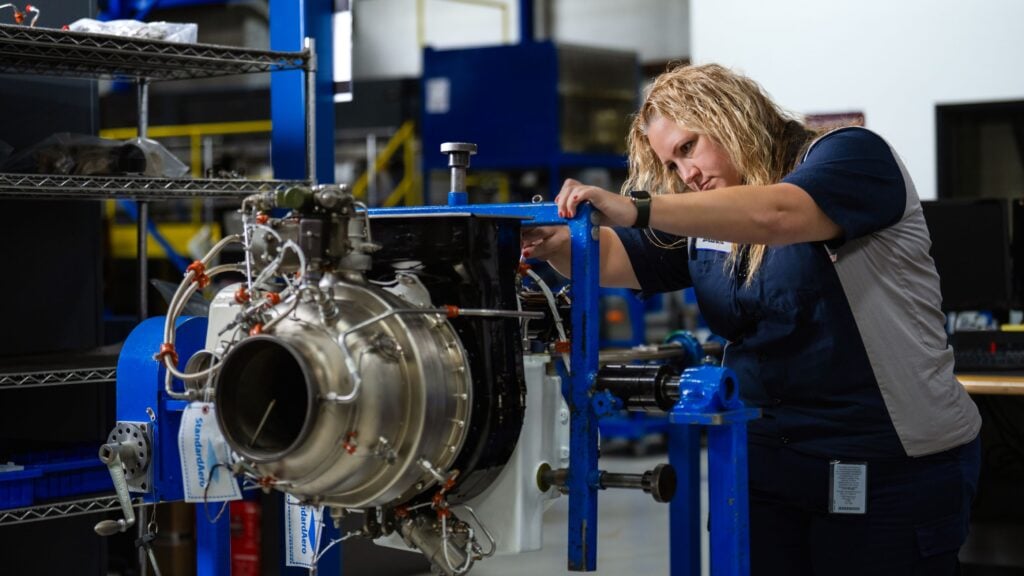
An auxiliary power unit (APU), usually located in the tail cone of an aircraft, but also in a nacelle or wheel well, is a small, independent, gas turbine engine. In simple terms, it is a self-contained generator which enables an aircraft to remain operable on the ground without the need for an external power source, such as a ground power unit (GPU). The APU is responsible for the provision of starting power for the main engines, and power for essential onboard systems along with electrical power and bleed air for cabin air conditioning. It also plays a role as a back-up power source in the event of engine generator failure. With its critical role when an aircraft is on the ground, we spoke to three MROs who are specialists in APU maintenance to get a better understanding of the challenges they face and how APU maintenance is carried out.
What are the key challenges in maintaining and repairing APUs compared to main engines?
Anthony Robbins, Honeywell 36 Series APU Team Leader (UK) at Standard Aero raises a key issue very early on, which relates to the fact that in comparison to an aircraft’s main engines, the APU is much smaller and usually well tucked away, bringing its own set of problems. “APUs are a key sub-system for modern airliners, providing a range of valuable functions including power for avionics and cabin lighting, air conditioning (hot or cold), and main engine start. However, they inevitably get less attention than main engines (being hidden in the aircraft’s tail cone), and this is sometimes reflected in the APU’s logbook history. Lead times for replacement parts and repairs can be a challenge, especially when MROs are competing with new production lines for parts,” he tells us. Mike DeMicco, Senior Vice President of Sales & Material Management at VAS Aero Services also identified problems with parts’ availability, commenting that: “Auxiliary Power Units present unique challenges in maintenance and repair compared to main engines, despite their smaller size and simpler design. Those challenges include increased wear and tear due to high thermal conditions and the limited monitoring and onboard diagnostic sensors which makes identifying and troubleshooting issues more difficult. Additionally, because APUs have such varied operations, maintenance planning can be more complex. Parts availability and specialised tooling may also be more limited than for main engines, leading to longer turnaround times.”
What are the most common maintenance issues encountered with APUs?
Where would we all be without oil leaks? Ring a bell with those of you more familiar with APUs? It certainly seems to be a recurring theme with our three respondents. Quincey Pagani, Director of APU Sales at Werner Aero is keen to point out that: “Due to frequent cycling, stress, and high heat, APUs are susceptible to some common maintenance issues.” She then goes on to explain that: “One of most common maintenance issue is due to oil leaks and excessive oil consumption which is often caused by worn seals and/or bearings. Another is caused by damage to the turbine blades and rotors due to stress at high temperatures, overall fatigue, or FOD which could cause cracks, warping, or rubbing. Starter motor failures can cause no-start conditions of the APU and additionally, malfunctions of the FCU can cause shutdowns.” Mike DeMicco feels that rates of use and certain problems are related. “APUs experience a range of maintenance issues, mostly stemming from their operating environment and usage patterns (frequent starts and stops, short run times, etc.). Problems may include oil system leaks or low oil pressure, starter motor and generator malfunction, and load compressors and bleed valves issues. All of these potential issues require routine inspection, condition monitoring and preventive maintenance to ensure reliable operation,” he says. To round off the topic, Anthony Robbins succinctly adds: “Two of the most common maintenance issues encountered with APUs are leaking compressor and generator seals.”
How should airlines decide between APU repair, overhaul, and replacement?
Once again Mike DeMicco sees this as a usage-related problem, as he tells us that: “Airlines strive to properly balance investment costs, maintenance downtime, and expected condition lifecycle. A repair is generally suitable for minor, isolated issues and offers the quickest return to service at the lowest expense. However, if the APU has high operating hours or multiple worn components, an overhaul may be more cost-effective for restoring the unit to a condition for extended service life.” He then goes on to point out that: “Replacement should be carefully considered when the cost of overhaul approaches or exceeds that of acquiring a replacement serviceable unit, while also taking into account the APU’s age and reliability record. VAS Aero Services acquires a high volume of aircraft annually for teardown, which gains access to APUs in different configurations and conditions to re-supply into the market to key customers. When a replacement need arises, VAS is ready to fill the gap.”
Quincey Pagani makes it clear that there are a whole range of factors that need to be taken into consideration when making such decisions between repair, overhaul, and replacement as she tells us that: “There are many factors that airlines need to consider when determining if an APU needs to be repaired, overhauled, or replaced such as: the time since last shop visit; the cost between repairing or overhauling; and overall market availability of units. If an APU has low time since its last overhaul and shows a minor fault, a repair could fix the issue and be the most cost-effective option. A repair can also be the best option for any APU lease returns. But, if there is lengthy time since the last overhaul and multiple findings presented during inspection, then an overhaul would be the best option as it would also offer better long-term reliability. A replacement could be preferred when an airline is looking to reduce operational downtime or phasing out their older APUs when it becomes too costly to maintain.”
For Anthony Robbins, the situation is less complicated. As he points out: “Honeywell APUs such as the GTCP36-150[RJ] are operated mainly on a ‘continued-time’ basis, with the unit being repaired as required to keep it functioning safely and reliably. This approach enables operators to avoid the cost of a replacement unit.”
What best practices can airlines adopt to extend the service life of their APUs?
As MROs will testify, the nature of their work is wholly dependent on the way airlines operate their aircraft. MROs can only advise on best practices and maintenance schedules, it is up to the carriers themselves to decide what they should do, providing everything still remains within the rules and regulations set out by regulatory bodies such as the FAA and EASA. Mike DeMicco explains: “To extend the service life of APUs, airlines must focus on proactive maintenance and efficient operation. Regular inspections and adherence to manufacturer-recommended maintenance intervals can optimise early detection of wear and potential failures. Monitoring key performance parameters can help identify issues before they lead to major component damage. Maintaining accurate service records and using data analytics to monitor trends play important roles in predictive maintenance, ultimately extending APU reliability and operational life. Meanwhile, in Anthony Robbins opinion: “Recommended best practices include ensuring that scheduled maintenance is performed, for example hot section inspections (HSIs). We also recommend that any defects identified are repaired as early as possible, i.e. to avoid the risk of any downstream damage, and that operators ensure that any erosion of hot section parts is addressed before becoming excessive (and thus potentially unrepairable).
Thinking outside the box is clearly a forte for Quincey Pagani as her solution of using the APU only when there is no alternative available makes perfect sense. “One of the best practices that airlines can adopt to extend the service life of their APUs is to use Ground Power / GPUs as much as possible when parked at the gate to utilise an alternative source of energy not related to the usage of the APU. Another would be to perform regular inspections, which would also include a borescope inspection, to help detect any signs of wear and/or damage that may need to be addressed. If the airline needs to store the APU for any reason, they should be following OEM-approved storage guidelines that helps ensure that while the APU is not being used it is preserved in a manner to help prevent any corrosion, contamination, and/or degrading of the seals,” she tells us.
How do modern diagnostic tools and predictive maintenance impact APU reliability?
Modern diagnostic tools streamline troubleshooting, enabling quicker fault isolation and repair. This minimises aircraft ground time and avoids costly delays. Advanced onboard monitoring systems now collect real-time data on key performance metrics such as temperature, vibration, oil pressure, and rotational speed. This data allows maintenance teams to track trends, identify deviations, and predict failures before they occur. VAS Aero Services’ Mike DeMicco expands further: “Data analytics-powered predictive maintenance helps optimise maintenance schedules based on actual APU usage and condition rather than fixed intervals. This reduces unnecessary inspections while ensuring critical issues are addressed promptly, extending component life and improving safety and operational efficiency.” Meanwhile, at Standard Aero, Anthony Robbins sums up the situation as follows: “The use of engine health monitoring (EHM) enables potential maintenance issues to be identified and addressed before causing an operational impact (i.e. an unscheduled removal), through the use of data trend analysis.”
What factors contribute most to APU maintenance costs, and how can they be mitigated?
Some of the major cost drivers for APU maintenance are from unscheduled removals, replacement of LLPs, pricing of spare parts utilised during repairs, or costly overhauls. One can help mitigate these costs by providing routine maintenance and inspections on the unit to catch any issues early on to prevent major failures and extend service intervals; utilisation of used serviceable material can help reduce repair/overhaul costs instead of installing costly OEM parts. Quincey Pagani goes on to inform us that: “Another item to consider would be installation of PMA parts, when approved, as they can also provide a significant decrease in cost during a shop visit. Also, repair contracts with APU repair shops can help mitigate high overhaul costs, such as with flat-rate agreements, by allowing for a better budgeting strategy and eliminating any high surprise charges.”
Anthony Robbins quickly identifies two principal ‘culprits’, telling us that: “The two biggest factors contributing to APU maintenance costs are the cost of replacement parts and the cost of repairs. Operators are able to mitigate these costs by following recommend maintenance best practices, and by ensuring that APUs are properly preserved during any extended downtime.” Mike DeMicco goes into slightly greater depth to highlight both problems and also solutions as he informs us that: “APU maintenance costs include labour, parts replacement, unplanned repairs, and aircraft downtime. Unscheduled removals and lack of spare unit availability can lead to costly aircraft downtime and logistical delays. High replacement costs for some components further drive up expenses. To mitigate these costs, airlines can implement predictive maintenance strategies that use real-time data to anticipate issues and schedule timely interventions. Working with parts supply partners such as VAS will allow the operator to maintaining a ready inventory of high-turnover parts by leveraging stocking and pooling arrangements, which will improve both cost control and operational efficiency.”
Are there any recent advancements in materials or design that enhance APU durability?
As the final question to this exploration into the world of APUs, we wanted to get a better feel for what has the potential to lead to their greater durability. “Recent advances in materials and design have significantly enhanced the durability of APUs, enabling them to withstand demanding environmental and operational conditions. New alloys being introduced are exhibiting exceptional mechanical properties and ceramic/carbon composites demonstrate a high thermal stability and oxidation resistance. Advances such as these should increase parts durability and have a direct impact on maintenance needs,” advises Mike DeMicco. Anthony Robbins gives a very clear and ideal example of such improvements when he tells us that: “On Honeywell APUs, recently introduced improved compressor and generator seals are helping to increase ‘on wing’ time,” while Quincey Pagani advises: “One of the most recent advancements in materials and design that can help enhance APU durability is by utilizing high-temperature alloys and coatings for parts installed in the hot section, such as the turbine wheels and compressors. This can help provide resistance to thermal stress and extend the life of the components and reduce the frequency of maintenance or replacement.”