
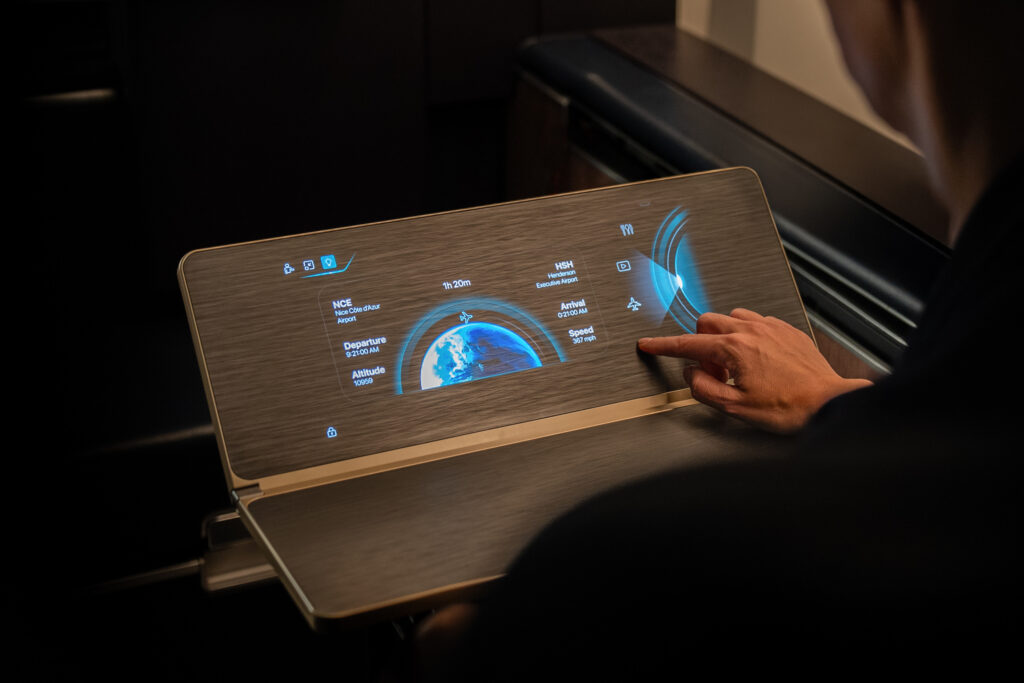
Lufthansa Technik has miniaturised the technology behind its ‘Hidden Touch Display’ to introduce a new form of user-interface integration inside aircraft cabins. The ‘nice intellitable’, which debuts at the Dubai Airshow, embeds a high-definition touchscreen directly into the premium haptic surface of a folding tray table. The interactive features appear only when requested by the passenger and disappear just as smoothly into the thin table surface when not in use.
The concept builds on the company’s award-winning ‘Hidden Touch Display’, which blends high-quality tactile surfaces with digital functionality, allowing control interfaces to merge effortlessly with cabin décor. Surface finishes can be customised to resemble wood, carbon fibre or metal, among others, enabling the technology to match a wide range of interior styles while maintaining a refined look and feel.
Unlike the earlier wall-mounted version, the fully customisable ‘nice intellitable’ significantly expands the range of integrated control options. The current demonstrator includes flight information, a moving map, seat-adjustment controls, a preview and ordering system for food and beverages, music and video players, and a digital magazine flip book. The table can therefore serve as both a functional workspace and a discreet control hub for the passenger experience.
When the tray table is needed for dining, all touch-interface elements can be minimised to a slim strip along the edge or switched off entirely. The smart surface is resistant to spills and the mechanical forces of cutlery or other hard items, ensuring it remains practical for mealtime use.
Andrew Muirhead, Lufthansa Technik’s Vice President Original Equipment and Special Aircraft Services, said the development responds to a gap between traditional cabin-control systems and how passengers actually interact with their surroundings. “Sometimes, there seems to be a disconnect between how airlines and VIP operators design their control solutions, and how their passengers actually interact with the cabin environment. To get rid of traditional control interfaces, which sometimes can feel bulky and outdated, we are permanently rethinking how technology integrates with interior design, creating more cohesive and natural interactions,” he said. “The ‘nice intellitable’ exemplifies this approach, redefining VIP, but also commercial business or first class cabins, through more intuitive and seamless technology that puts both passenger experience and airline needs at the centre.”