
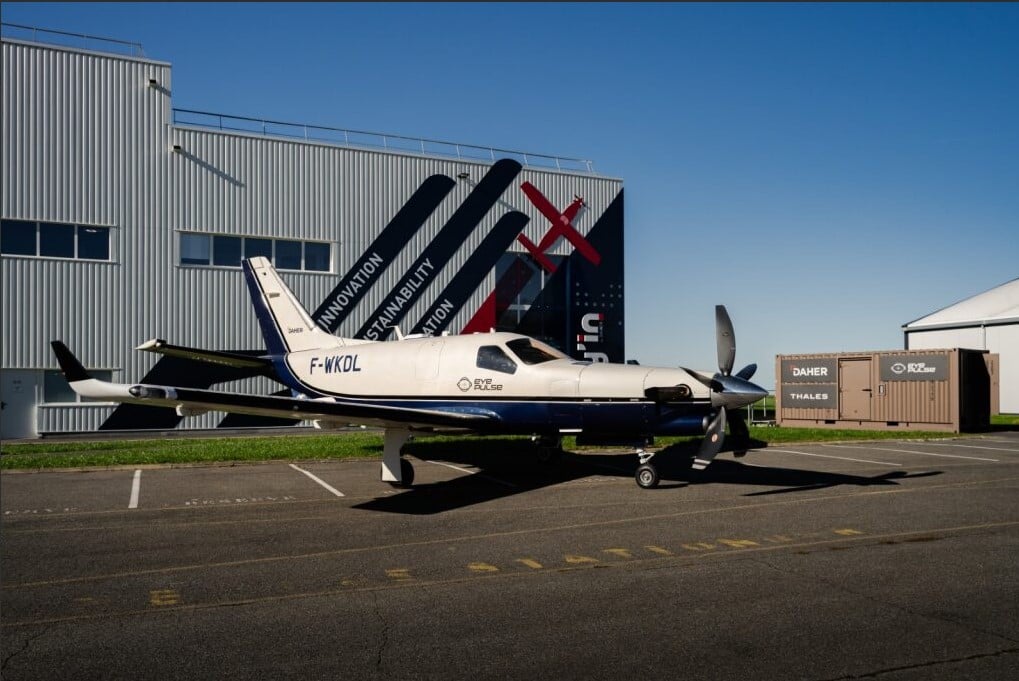
Daher has completed a successful flight demonstration of Eye Pulse, its prototype medium-altitude long-endurance (MALE) drone, presented to the Directorate General of Armaments (DGA) under a call for projects agreement. The first flight, conducted at Tarbes, represents a major milestone for the company, demonstrating its ability to deliver quickly and respond effectively to defence requirements. Developed in under six months through a partnership with Thales, the Eye Pulse demonstrator meets the DGA’s ambition to accelerate the strengthening of drone capabilities for the French armed forces and for export.
The demonstration featured a fully automated sequence, including an autonomous landing phase. As architect and project lead, Daher integrated the Thales ScaleFlyt avionics suite onto an existing platform, enabling a fully autonomous flight sequence triggered from the ground. The activation was carried out by IGCEA Alexandre Lahousse, deputy director general of the DGA, who attended the demonstration with a DGA delegation.
Thales provided the remote piloting system, ground station, and ground-to-air command and control data link. Its interoperable control technology complements the advanced design of Eye Pulse, which is capable of automatic and autonomous operation. The flight highlighted the strong synergy between the two companies, combining Daher’s platform integration expertise with Thales’ avionics and control systems.
Drawing on certified civil-sector technologies, the programme reflects Daher’s agility and its efficient industrial ecosystem. The company leveraged its long-standing aircraft manufacturing capabilities and civil aviation approvals to develop Eye Pulse. Its Fly’in technology centre in Tarbes, with capabilities in rapid prototyping, engineering, artificial intelligence, and embedded systems testing, played a central role in enabling swift integration of Thales technology into the demonstrator.
With its modular architecture and interoperable systems, Eye Pulse is designed to evolve in line with operational needs. The platform can be adapted to varied missions and specifications, supporting future doctrines of use as defence requirements continue to develop.