

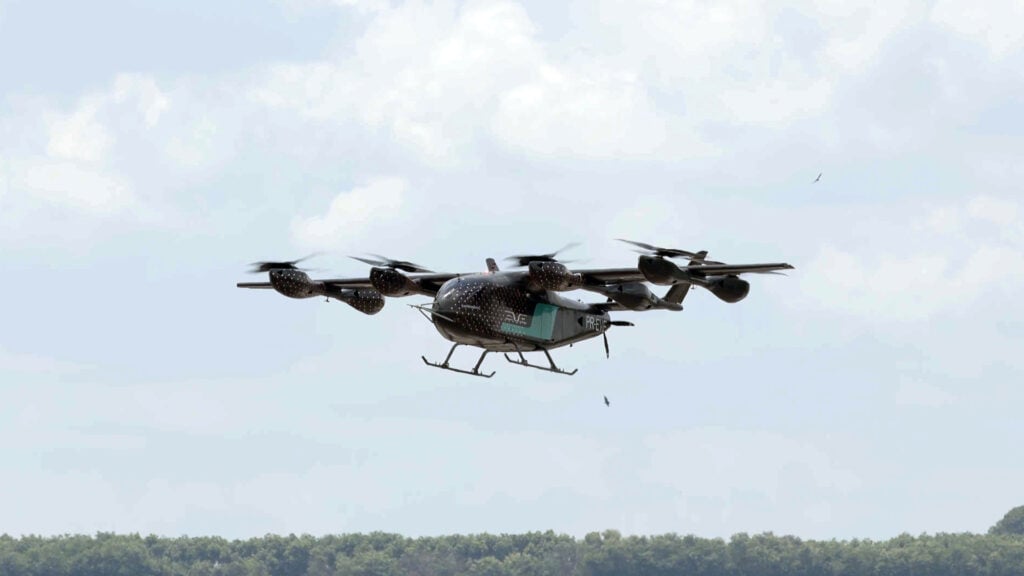
Eve Air Mobility has completed the hover and low-speed phase of flight testing for its full-scale engineering prototype, marking another key milestone in the development of its electric vertical take-off and landing (eVTOL) aircraft.
The latest stage of the programme delivered what the company described as high-fidelity operational data and valuable technical insights as Eve prepares to move into transition flight testing later this year. The tests form part of the company’s step-by-step development strategy, designed to progressively expand the aircraft’s flight envelope while validating simulation models, control laws and real-world flight behaviour.
During the campaign, the prototype demonstrated stable hover capability and predictable handling across increasingly demanding manoeuvres. Initial low-speed testing was carried out below 15 knots, focusing on validating flight control systems, downwash behaviour, thermal performance and propulsion modelling.
As the programme advanced, testing expanded to around 20 knots of ground speed and included simultaneous four-axis manoeuvres to further assess aerodynamic performance and structural load models ahead of higher-speed operations and larger control inputs.
Eve completed more than 100 individual flight test points during the phase. The aircraft also successfully demonstrated its autoland capability and a simplified fly-by-wire mode designed to operate as a secondary control layer should the primary system become unavailable.
The prototype reached an altitude of 215 feet above ground level and achieved a maximum flight duration of three minutes and 48 seconds. According to Eve, the aircraft displayed consistent behaviour throughout testing, including under complex multi-axis inputs.
The company added that recorded noise levels met expectations, while battery and propulsion system performance exceeded projections during the evaluation period.
Over the coming weeks, Eve will carry out further ground testing in preparation for the next phase of development — transition flight testing — scheduled to begin during the summer of 2026. That phase will focus on expanding the flight envelope further and validating aircraft performance as the programme progresses towards wing borne flight operations.