
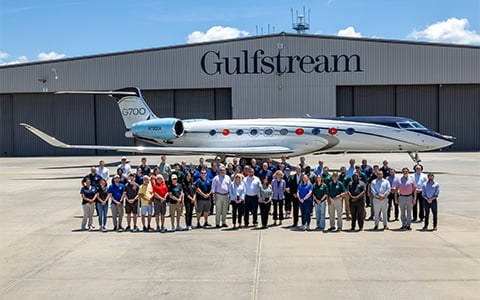
Rolls-Royce has announced that its Pearl 700 engines have successfully powered the first flight of a Gulfstream G800 using 100% sustainable aviation fuel (SAF), marking a significant milestone in efforts to reduce non-CO₂ emissions from business aviation.
The flight formed part of Gulfstream Aerospace’s high-altitude flight test campaign to assess the potential of neat SAF to reduce the particulate emissions that contribute to contrail formation at altitudes of up to 50,000ft.
The G800 was accompanied by a specially modified Gulfstream G700, also powered by Pearl 700 engines, which served as a flying emissions laboratory. Flying in close formation, the aircraft enabled researchers to collect real-world data on particulate emissions and atmospheric conditions at altitudes typical of business aviation operations.
Led by Gulfstream Aerospace, the campaign brought together the US Federal Aviation Administration (FAA), NASA, the German Aerospace Center (DLR), Missouri University of Science and Technology, Rolls-Royce, Aerodyne Research, Montana Renewables and World Fuel Services. The programme compared conventional Jet A fuel, low-sulphur Jet A and neat hydroprocessed esters and fatty acids (HEFA) SAF to evaluate the effect of fuel composition on non-CO₂ emissions.
Preliminary findings indicate that neat SAF, which contains no sulphur or aromatic compounds, significantly reduces the particulate emissions associated with contrail formation.