

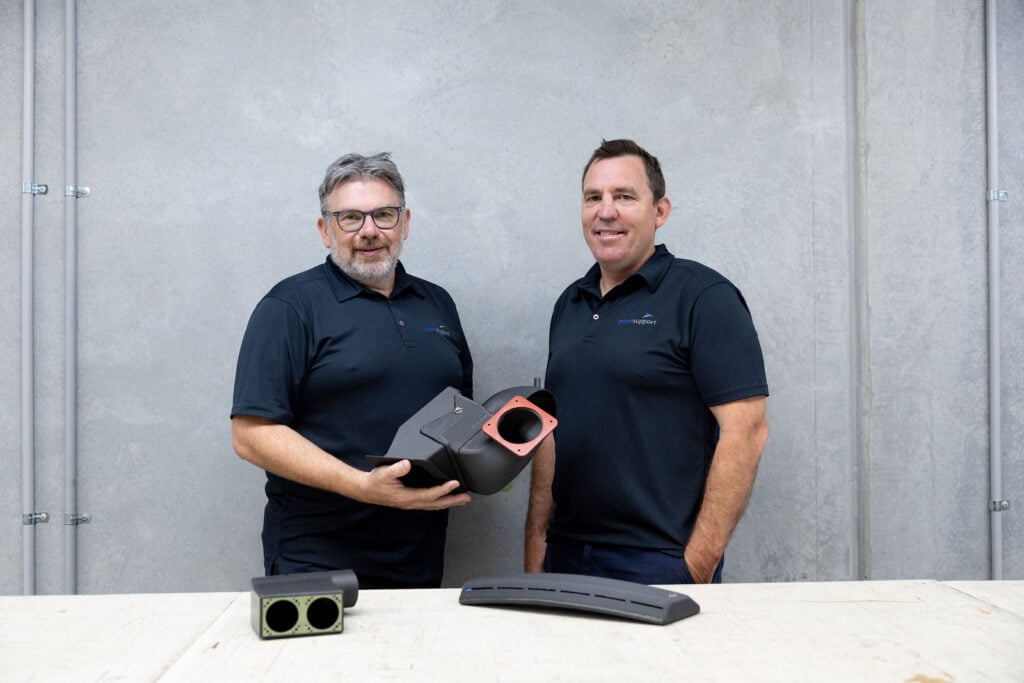
Australian aerospace engineering company Plane Support has secured Civil Aviation Safety Authority (CASA) approval to manufacture cabin air-conditioning ducting for the 214B helicopter using 3-D printing, in a project initiated by aerial firefighting and disaster response operator McDermott Aviation.
The approval, granted under CASA’s Australian Parts Manufacturer Approval (APMA) framework, covers ducting components for the Bell 214B (B-1) and follows nearly two years of development by the companies in consultation with the regulator.
McDermott Aviation, the world’s largest operator of the 214B and holder of the aircraft’s type certificate, initiated the project to improve access to replacement parts for its fleet, some of which can be difficult to source.
“An aircraft waiting on a component you can’t easily get hold of is an aircraft that isn’t working,” said John McDermott, founder and President of McDermott Aviation.
“Being able to have approved parts made here in Queensland gives us far more control over that.”
Plane Support used 3-D scanning to capture the original ducting and create accurate digital models. The components were then reverse-engineered and redesigned for additive manufacturing while retaining their original form, fit and function.
The company established a dedicated aerospace additive manufacturing laboratory for the project, equipped with a Markforged FX10 industrial 3-D printer. It also developed the quality systems, production controls and inspection procedures required to meet CASA’s airworthiness standards.
The approval expands Plane Support’s capabilities under CASA’s Part 21K framework for additive manufacturing and could provide a basis for producing additional aircraft components using the technology.