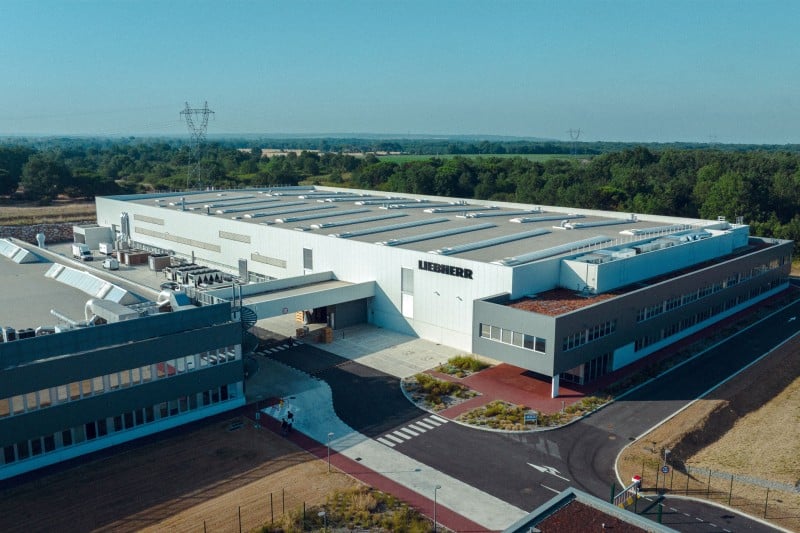
Liebherr-Aerospace Toulouse has invested more than €40 million in a new centre of excellence for aerospace heat transfer equipment at its Campsas site near Toulouse, France, doubling the facility’s floor space as it prepares for higher production volumes and future aircraft programmes.
The 12,000 m² facility represents the largest industrial investment in the company’s history. It brings together advanced manufacturing and repair capabilities to support demand from existing aircraft programmes while developing technologies for next-generation aircraft.
Liebherr-Aerospace has operated at Campsas since 2001, progressively expanding its precision machining activities. The site now manufactures and repairs heat transfer equipment used in aircraft environmental control and thermal management systems.
The new centre incorporates surface treatment lines, an automated brazing robot, brazing furnaces, welding equipment, inspection systems and a spacer-forming press developed by Liebherr. The equipment is intended to increase production capacity and improve manufacturing capabilities as aerospace production rates rise.
The company expects its Campsas workforce to reach nearly 400 employees by the end of 2026.
Heat transfer equipment plays a key role in regulating cabin temperature and pressure and cooling aircraft systems. Liebherr said the technology would become increasingly important in future aircraft, particularly for managing energy use and dissipating heat.
The investment is designed to meet demand for thousands of aircraft still to be delivered based on current designs, while supporting the development of technologies for future aircraft architectures.
Liebherr-Aerospace is also preparing for more automated and digitally integrated manufacturing through DIGIFab, a collaborative project supported by France’s Directorate General for Civil Aviation (DGAC) under the Council for Civil Aeronautical Research (CORAC). The initiative aims to accelerate digitalisation and automation in heat transfer equipment production.
The expansion involved transferring operations from Toulouse to Campsas, installing new equipment and increasing production capacity while maintaining manufacturing continuity and customer deliveries.