
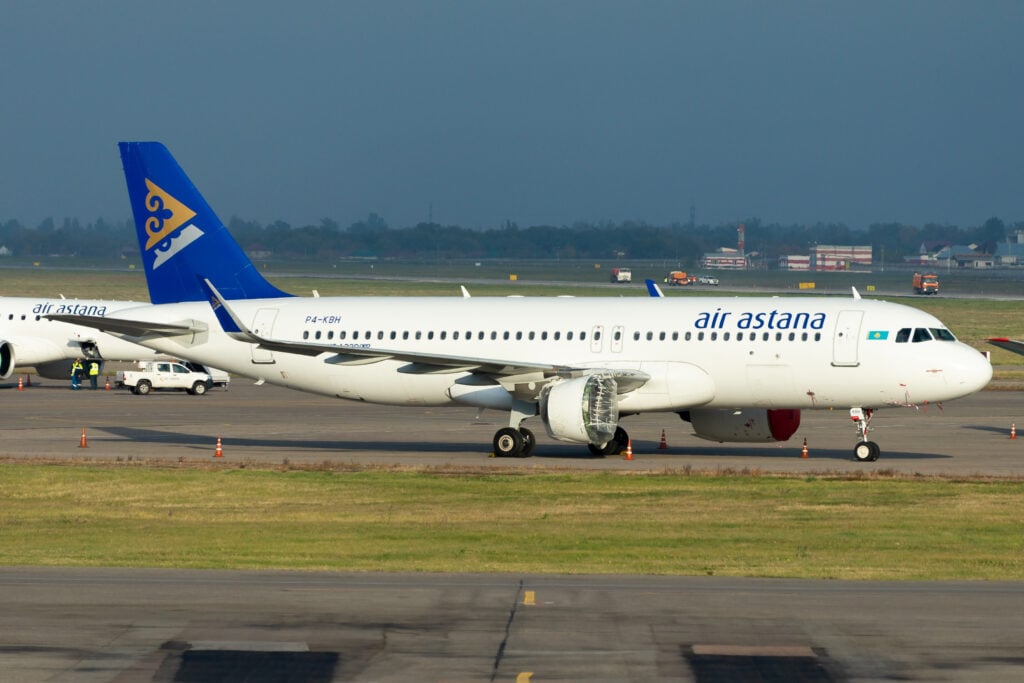
Some ten kilometres from the eastern coastline of Spain and approximately 30 kilometres north of Castellón de la Plana lies a small and relatively insignificant single-runway airport, Aeroport de Castelló. Until recently it was semi-deserted, but as a result of an ongoing global engine crisis, the airport has become extraordinarily busy, but not with tourists and passengers, no. Operating from a large building half-way along the runway is UK-based ecube, which was recently acquired by Satair, a subsidiary of Airbus. The nature of its work? Aircraft teardowns.
However, what makes this scene remarkable is not its seemingly strange location, but the aircraft themselves. The airport has not become a graveyard for the inevitable dismantling of aged aircraft which have reached the end of the road. Instead, Aeroport de Castelló has become the final resting place for nearly new Airbus A321neo jets. Where once you could expect a commercial aircraft such as the Boeing 737 to remain operational for 20 to 30 years, the aircraft being cannibalised at the airport are Airbus A321neos and they are roughly only six years old.
So, what is going on? How can a perfectly serviceable aircraft with at least fifteen more flying years ahead of it be confined to the scrap heap so early on? There are two very surprising reasons, namely its port engine and its starboard engine. However, it is not that there is anything wrong with them. On the contrary, it is because the engines are in perfect working order that the plane is being torn down.
The seeds of today’s problem were first sown when oil prices had exceeded the US$140-a-barrel mark. This coincided with a period of time when considerable effort was being put into new engine designs. Almost overnight the focus shifted from durability to efficiency. “They went too fast, and the engines had great improvements in efficiency, but they failed on maintenance,” a leading aviation economist told Reuters news agency during a recent International Society of Transport Aircraft Trading (ISTAT) event. That has, inadvertently, led to problems being faced by operators of the A321 today.
The A321neo is powered either by two Pratt & Whitney PW1000G (a.k.a. the GTF) engines, or two CFM International LEAP1-A engines, and those operators who opted for the Pratt & Whitney engine are facing several problems which have resulted in a shortage of both engines and parts for repairs. In 2023 Pratt & Whitney disclosed a rare powder-metal defect that could cause cracking, prompting calls for inspections of 600-700 GTF engines through 2026. In addition, there have been ongoing supply chain problems which have resulted in long repair waiting times, while there is currently a severe shortage of these next-generation fuel-efficient engines. The immediate result can be seen in the fact that according to Reuters and Cirium data, one-third of the GTF-powered Airbus fleet or 636 jets are grounded or in storage. The equivalent percentage for planes with engines from competitor CFM is 4%.
As a consequence, the economic basics of supply and demand have seen the value of a single GTF engine soar to the point where the two engines from an A321 alone are worth more than the entire jet in operational condition. “I can’t say I remember it happening on this scale before, because we’ve never had an issue like this on such a popular engine,” said Lee McConnellogue, CEO of ecube, advising that the company can release usable parts or recycle virtually the whole jet. This imbalance in supply and demand has led to more than a dozen Airbus jets being dismantled for parts after only a few years in service, while industry insiders believe there are dozens more that may be destined for the same fate. For example, questions are being asked about the future for Airbus jets currently being discarded by Spirit Airlines as it faces bankruptcy proceedings. “I don’t think the die is completely cast on what’s going to happen to Spirit, but it’s inevitable that some of those aircraft will (be broken up),” McConnellogue commented.
To look more closely at the maths and again according to Cirium, a single GTF engine can be rented out for US$200,000 a month, US$400,000 a pair, which is not far off the cost of leasing the whole aircraft. If you then look to strip down the airframe for parts, what ecube is doing makes perfect financial sense. According to Austin Willis, CEO of Willis Lease, “It’s a paradox where there’s so much demand, why on earth would people be parting out aircraft?” However, airline leaders are now questioning how aircraft built to fly for more than 20 years and to be so fuel efficient are being dismantled at such an early age. “It tells you something is seriously wrong,” said Willie Walsh, head of the International Air Transport Association, which last week predicted US$11 billion in costs from supply disruption this year including US$2.6 billion in engines alone.
Today, engine executives argue that the fuel savings benefit airlines on every mile flown, while maintenance delays are temporary. However, Pratt & Whitney have admitted that it will take years to end bottlenecks. Does this mean that more and more MROs who deal in USM will be eyeing up the A321neo with GTF engines for part-out, and is the shortage of engines now being looked upon as a long-term problem?
What do others directly involved with the situation think?
We approached Setna iO, a leading aftermarket aircraft part supplier headquartered in Chicago and who bought the two A321neos referenced above to learn more about the situation on the ground. We have also been fortunate enough to receive feedback from ACC Aviation who are headquartered in London, England.
AviTrader: How did we reach a point where A320neo-family aircraft powered by Pratt & Whitney engines are worth more in parts than as operational assets?
One gets the sense this situation has arisen as the result of ‘the perfect storm’ where Tristan Brouard, Associate VP Asset Management at ACC Aviation is concerned. He explains that; “We arrived at this point through a convergence of structural and operational pressures that hit the market simultaneously. The Pratt & Whitney GTF fleet encountered a series of durability and inspection mandates that removed hundreds of engines from service, which in turn grounded a significant portion of the A320neo fleet. What followed was a prolonged period in which demand for engines, modules, and LLPs dramatically exceeded supply. In effect, the market bifurcated: values for complete aircraft softened due to operational uncertainty, while values for part-outs surged because engines and major components became scarce, liquid commodities. When airlines are desperate for lift and lessors are desperate for engines to keep contracted aircraft on lease, the intrinsic value shifts from the platform to the parts that keep the platform flying. That is exactly what happened here. On a slightly different tack, David Chaimovitz, CEO at Setna iO feels there is no single driving factor as he tells us that: “Many factors have made certain very young aircraft are worth more in pieces than as operational assets. The main driver is the poor durability of many GTF engines, which are being removed from wing far earlier than anticipated, causing massive shop backlogs and driving up the prices for serviceable lease engines. There is also airline bankruptcy and the associated transition costs that will drive much of this activity.”
Are investors or lessors viewing the P&W-powered A320neo family of aircraft differently from CFM-powered variants?
Tristan Brouard is adamant this is very much the case. “Absolutely. The market now assigns different risk premiums to GTF-powered and CFM-powered A320neos. While the broader A320neo family remains an exceptionally strong asset class, the GTF issues have created a divergence in investor sentiment. Lessors and institutional investor’s view P&W-powered aircraft with a more conservative lens due to expected downtime, weaker utilisation profiles, and higher near-term maintenance exposure. CFM-powered aircraft, by contrast, benefit from a more stable operational track record and therefore retain stronger liquidity and lease-rate factors. In practical terms, this means investors are underwriting GTF-powered aircraft with wider stress cases, with potentially higher maintenance provisioning, and more stringent credit requirements for lessees,” he tells us. David Chaimovitz seems to sense it is not the engines that are being viewed differently, but that market factors affect our perspective, acknowledging that: “There is strong demand for both GTF- and LEAP-powered aircraft. These early part outs are not a sign of weakness. They are simply a sign that in certain situations, it is more economic to part out airframes and lease the engines.”
How are leasing companies recalculating asset values for A320neo-family aircraft equipped with P&W engines?
While David Chaimovitz does not think they are being significantly re-calculated, Tristan Brouard senses that leasing companies are moving away from traditional book-value assumptions and instead are basing their valuations on scenario-driven cashflow models. As he comments, “In effect, the aircraft are being valued more like ageing assets with non-standard risk profiles, despite being relatively young units.”
Does this signal a shift toward viewing aircraft as “parts banks” rather than long-term assets?
Here David Chaimovitz is reluctant to agree, seeing this more as a temporary phase. “I doubt this trend will last past all current engines having their first shop visits and associated AD’s accomplished. There will always be niche situations where part out provides more value than continued leasing, but I believe this is a special situation that will not be occurring too often a few years from now,” he shared with us. Tristan Brouard would seem to be in accord with Chaimovitz in terms of a temporary versus permanent change. He explains: “Not in a structural or permanent sense but in the short to medium term, yes, the market is temporarily behaving that way. When engines become bottlenecks, the asset with the highest marginal utility is the one that can return thrust to an operator today. That makes parted-out engines and modules far more valuable than the aircraft as a whole. However, this is a cyclical distortion, not a fundamental redefinition of the A320neo market. Once supply chains normalise and engine reliability stabilises, these aircraft will once again be treated primarily as long-term revenue-generating assets. For now, the ‘parts bank’ mentality is a rational response to extraordinary constraints.”
Have recent Pratt & Whitney repair and recall campaigns improved the situation, or are the shortages still deepening?
In simple terms, Tristan Brouard feels things are going to get worse before they get better. He advises that: “The campaigns have improved transparency and predictability, but they have not yet eased the practical constraints. The capacity of the MRO network remains the limiting factor. Mandatory inspections, coupled with the replacement of powder-metal components, continue to place enormous pressure on turnaround times. While the long-term outlook is improving, the short-term reality is that the shortages are deepening before they get better.” Meanwhile, David Chaimovitz sums up the situation in a nutshell as he tells us that: “34% of the A320neo GTF fleet is currently parked, and shop visits are still taking 300 days. The issues have not been alleviated.”
How has the market for second-hand A320 components evolved over the past two years?
According to David Chaimovitz, “A320neo airframe components are probably 90% interchangeable with older A320ceo components. There is massive demand for components to support the 11,000+ A320s currently operating globally. Supply is stable and prices are steady, without any major increases or decreases over the previous few years, post the massive lockdown induced collapse and subsequent rebound in values.” Looking at the situation from a different perspective, Tristan Brouard believes there have been significant changes, advising that: “The second-hand component market has undergone a dramatic transformation. Two years ago, trading activity was modest, largely because the fleet was young and not yet cycling through major maintenance events. Today, it is one of the most liquid and aggressively priced segments in the single-aisle market.”
He adds that: “Key trends include:
• Significant increases in pricing for both engine LLPs and high-demand accessories.
• Record-high transaction velocity as operators compete for limited modules to keep their fleets flying.
• Greater participation from lessors who are stripping aircraft to re-deploy components across their portfolios.
• Emergence of specialised funds interested in parts arbitrage rather than whole-aircraft leasing.”
He concludes: “In short, the secondary market has shifted from a supplementary ecosystem to a critical lifeline for operators and lessors managing grounded GTF fleets.”