
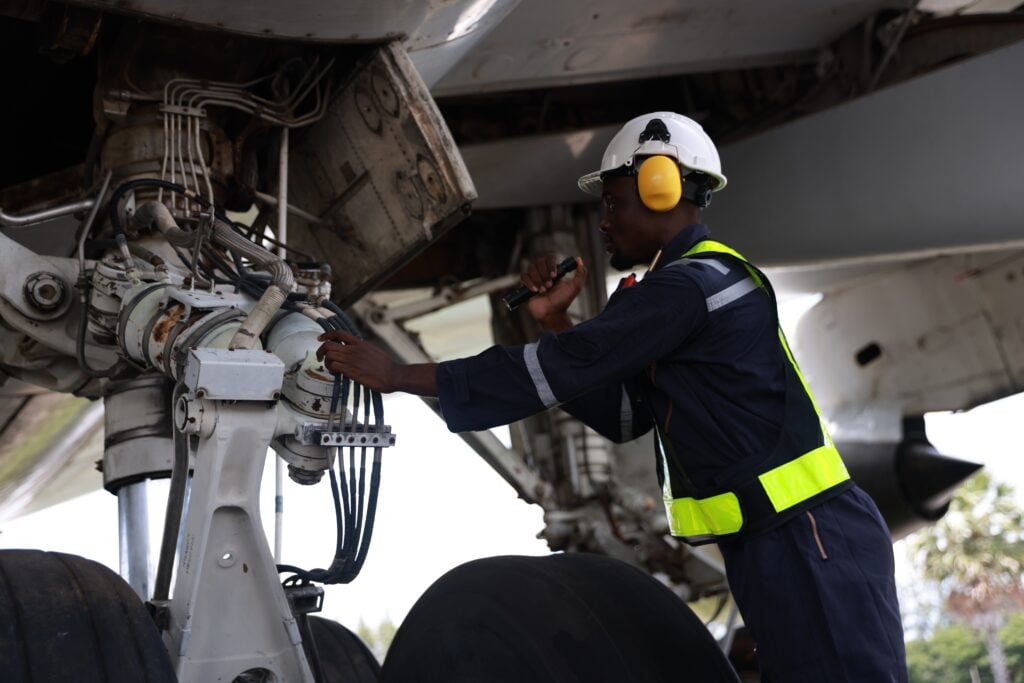
In the world of aircraft maintenance, there is a temptation to pay almost too much attention to heavy checks and major overhauls, but then it is difficult not to. After all, these are major events and if we were to look at a C-check for a wide-body jet, this takes an inordinate amount of planning and organising, involves huge amounts of manpower, and will incur a significant cost. Because this is such a major undertaking, it is highly ‘visible’ and therefore tends to overshadow line maintenance, leading to the misconception that line maintenance is of appreciably less importance. While line maintenance is perhaps classed more as ‘routine’, is fast-paced and operationally driven, a heavy check is seen more as the ‘big brother’, the ‘serious maintenance’ which guarantees airworthiness. But surely this is a narrow-minded opinion and a misunderstanding of the role of line maintenance as it is most definitely not secondary. Without question it is front-line safety work which plays a key and immediate role in ensuring aircraft integrity.
Line Maintenance Is the First Barrier to Operational Risk
Line maintenance is very much a part of daily aircraft operations as it involves walkaround inspections, defect rectification, troubleshooting, component replacement, and compliance, with minimum equipment list requirements. Such activities take place under tight time constraints, often between flights, and directly determine whether an aircraft is safe to fly. When you look at the situation more realistically, heavy maintenance focuses more on long-term structural integrity, involves scheduled inspections and is more a proactive action, while line maintenance ensures that immediate operational risks are identified and controlled and by its very nature is more proactive. A defect discovered on the line is not theoretical—it is a real-time airworthiness concern that must be addressed before the very next flight.
High-Pressure Conditions Increase Criticality
Line maintenance is a very high-pressure environment that can sometimes have to be carried out in the most challenging of weather conditions, at night as well as during the day, with limited access and frequently narrow time windows. Such conditions make line maintenance uniquely critical as the ability to troubleshoot accurately, apply procedures correctly and maintain discipline under time pressure is essential for safe flight operations.
Some of the smallest tasks can have the greatest of consequences
As the expression goes, “size isn’t everything”, and just because some line maintenance tasks may seem petty in relation to tasks carried out during a heavy check, their importance shouldn’t be underestimated. For example, while replacing a sensor, troubleshooting an avionics message, or addressing a tyre issue may seem routine and straightforward compared with structural inspections or major system overhauls, aviation safety is not determined by the size of the task, but by its impact on dispatch readiness. Many significant incidents begin with minor unresolved or unnoticed defects, though line maintenance is often where early warning signs appear, and where the opportunity exists to resolve the problem. Consequently, line maintenance is not ‘less important work,’ but critical work carried out at the most operationally sensitive stage.
The Complexity of Modern Aircraft Makes Line Maintenance More Demanding
Modern aircraft are increasingly dependent on integrated avionics, software-driven systems, and digital fault monitoring and as a direct result, maintenance technicians now have to interpret fault codes, evaluate system messages, and distinguish between transient alerts and genuine failures. Troubleshooting is often more complex than simple part replacement, but skills which require deep systems knowledge and exceptional diagnostic skills. The line environment is therefore not only fast-paced but technically demanding, so in many cases, line maintenance teams are the first to encounter and identify new failure patterns, which makes their expertise essential for fleet-wide reliability.
Heavy Checks and Line Maintenance Are Complementary, Not Hierarchical
Heavy maintenance and line maintenance may serve equally vital functions, but they are very, very different in terms of execution. For example, heavy checks address long-term airworthiness through deep inspections, structural repairs, and major planned interventions, whereas line maintenance ensures day-to-day operational safety, defect management, and dispatch integrity. Any misconception likely occurs when these functions are compared as if one is more important than the other. In reality, aviation safety is equally dependent on both as heavy checks provide the foundation of long-term reliability, while line maintenance provides the continuous real-time assurance that aircraft remain safe between those checks.
Line Maintenance as the Face of Safety Culture
While a C-check may be ‘seen’ as a major and therefore interpreted as a more important event, in reality, line maintenance is usually the most visible maintenance function to flight crews, dispatchers, and passengers. It is where safety culture is demonstrated daily through professionalism, discipline, and attention to detail and those in charge must have the confidence and courage to stop a departure if there are any concerns. In many ways, line maintenance is where the operational safety system is tested most directly as the decisions made on the line have immediate consequences where flight safety is concerned.
Conclusion: Line Maintenance is Frontline Airworthiness
From the above, you may now be able to see that the myth that line maintenance is less critical than heavy checks overlooks the true role of line work in aviation. Line maintenance is not simply routine servicing; it is the frontline defence that ensures aircraft are safe, legal, and reliable whenever they take to the skies. Performed under high pressure and demanding conditions, line maintenance requires technical expertise, procedural discipline, and strong safety judgment and though heavy checks may be larger in scale, line maintenance is immediate in impact. The outcome? In the realms of commercial aviation, airworthiness is not assured solely by work carried out in the hangar—it is also assured on a daily basis on the line, one dispatch after the next…