
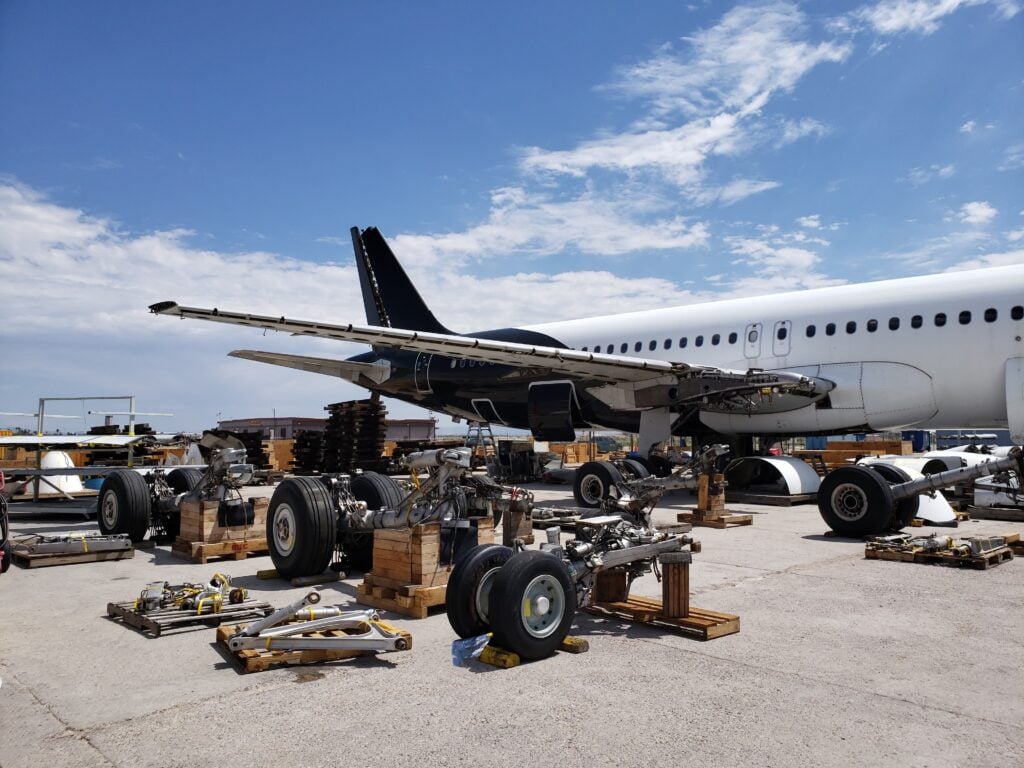
In many ways, the end of the life of an aircraft is not that dissimilar to the end of the life of a human being. Admittedly the end of an aircraft’s life can be more easily planned, and fortunately very few aircraft end their life in an accident. However, where there is a tremendous similarity is what can happen afterwards.
If you think about it, the understanding of the human anatomy, our physiology and how the body functions was only discovered through post-mortem dissection. Even today, most medical students have their own cadaver through which they learn so much about anatomy, surgery, and how the body ages over time, and it is that last factor that an aircraft teardown can reveal. How the aircraft has weathered the passage of time.
An aircraft teardown is the best opportunity to discover what has been going on in those hard-to-reach areas, as well as discovering how repairs and maintenance procedures have coped with the passage of time. Thus, an aircraft shouldn’t just be seen solely as a supply of USM, but a means of inspiration and driving factors for technical improvement. For maintenance organizations, teardown inspections offer lessons that are difficult, if not impossible, to obtain or recreate through routine in-service inspections alone. They challenge assumptions, validate or contradict maintenance programmes, and often reveal failure mechanisms that only come to light after tens of thousands of flight hours.
The Difference Between Theory and Reality
Maintenance programmes are built on a combination of engineering analysis, service experience, and regulatory guidance. While these programmes may be extremely effective, one of the biggest problems with them is that they are based on assumptions about usage, environment, and human behaviour. The wonderful thing about teardown inspections is that they provide a rare opportunity to test those assumptions against reality.
And the result? A gap between predicted and actual wear often emerges. Components expected to show uniform degradation may display highly localised damage. Structural areas assumed to be benign can exhibit corrosion or fatigue that had not been anticipated, while other areas may well have performed better than expected. These findings are not failures of engineering—they are reminders that aircraft operate in complex, variable environments that no model can fully capture as no two aircraft have identical lives. Thus, as we have discovered through teardowns, operational factors such as short-haul cycles, high humidity, de-icing exposure, and maintenance access constraints play a far greater role in long-term degradation than many maintenance planners may well have initially assumed.
Hidden Damage in Hidden Places
One of the most valuable aspects of teardown inspections is the provision of access to previously unexplored areas. Because panels are removed permanently and insulation is stripped away, and structures that are rarely—if ever—fully exposed during routine maintenance become visible.
Unsurprisingly, corrosion is a frequent and instructive finding. Teardowns often reveal moisture trapped behind insulation blankets, under floor panels, or in lap joints where drainage is limited. In many cases, the corrosion has progressed slowly and predictably, yet it has remained undetected because it developed in areas that are difficult to inspect. Such discoveries have led to changes in inspection intervals, access requirements, and more thorough and comprehensive corrosion prevention programmes across multiple aircraft types. Fatigue cracking provides similar lessons. Small cracks may be found in areas that technically comply with inspection requirements but are challenging to inspect effectively in practice.
Components Tell Their Own Story
Beyond structure, teardown inspections provide invaluable insight into what happens to components over time. On teardown, it will soon be discovered that items such as actuators, valves, pumps, wiring bundles, and brackets clearly show wear patterns that differ significantly from what was anticipated during the design phase or during early service life. Such discoveries include fretting damage caused by micro-movement, chafing due to subtle installation tolerances, and thermal degradation in areas exposed to unexpected heat sources. In some cases, components removed “on condition” during service life are found to have substantial remaining margin, while others fail in ways that were not predicted by existing reliability data.
These observations are more important than you might at first imagine, as each small observation creates a larger mosaic which can help to shape reliability programmes, task card design, and parts replacement strategies. These observations also underscore the value of teardown data as a complement to operational reliability reporting, which may not capture slow-developing or non-dispatch-critical degradation.
Maintenance Practices Leave Long-Term Signatures
As we touched on earlier, teardowns also provide a true-life as opposed to theoretical assessment of maintenance practices over an aircraft’s life. Fastener condition, sealant application, repairs, and modifications all leave long-term signatures that become clearly visible once the aircraft is fully stripped out. In some cases, well-executed repairs age exactly as anticipated, blending almost seamlessly into the surrounding structure. However, in other instances, minor deviations from best practice—improper surface preparation, marginal sealing, or non-optimal fastener selection—become focal points for corrosion or cracking which doesn’t occur until decades have passed.
Findings from teardowns reinforce the long-term importance of quality workmanship. Decisions made under schedule pressure during a routine check can influence the overall structural health for the remainder of the aircraft’s life. Teardown inspections help to double underline the magnitude of such a cause-and-effect relationship.
Feeding Lessons Back Into the System
Of course it is one thing to make various impressive discoveries during teardown. However, it is what is done with that information that dictates just how important any discoveries are. When teardown data remains isolated within asset management or part-out organisations, the potential improvements to safety and reliability remain unachievable, and that is a total waste of critical information.
The most effective programmes ensure that teardown findings are shared with OEMs, regulators, operators, and MROs. The result can mean that structural inspection programmes are refined, corrosion prevention measures are updated, and maintenance task cards are adjusted to reflect real-world aging behaviour. It can frequently be shown that in certain cases, teardown data has directly influenced airworthiness directives, service bulletins, and supplemental inspection programs. One shouldn’t forget that teardown inspections also play an increasingly important role in the management of ageing fleets. As the average aircraft age continues to rise across many sectors, historical teardown data is now providing an invaluable roadmap for anticipating future issues, enabling MROs to be proactive as opposed to reactive.
More Than an End-of-Life Activity
There is a temptation to view teardown inspections as a purely end-of-life exercise, driven by asset recovery rather than safety. However, this would be a massive mistake as, in reality, teardowns represent one of the most information-rich feedback mechanisms available to the MRO community. When you think about it, every aircraft that is dismantled carries the accumulated history of its operation, maintenance, and working environment. Teardown inspections translate that history into tangible data lessons—lessons that can improve inspection effectiveness, refine maintenance programmes, and ultimately enhance current and future safety requirements of aircraft.
So, next time you come across an aircraft teardown, don’t look upon it as a lifeless entity that no longer serves any worthwhile function apart from becoming a donor of spare parts. Instead, look upon it as a still active aircraft that has more than a few revealing stories to tell about its past that it is only now able to tell you.