

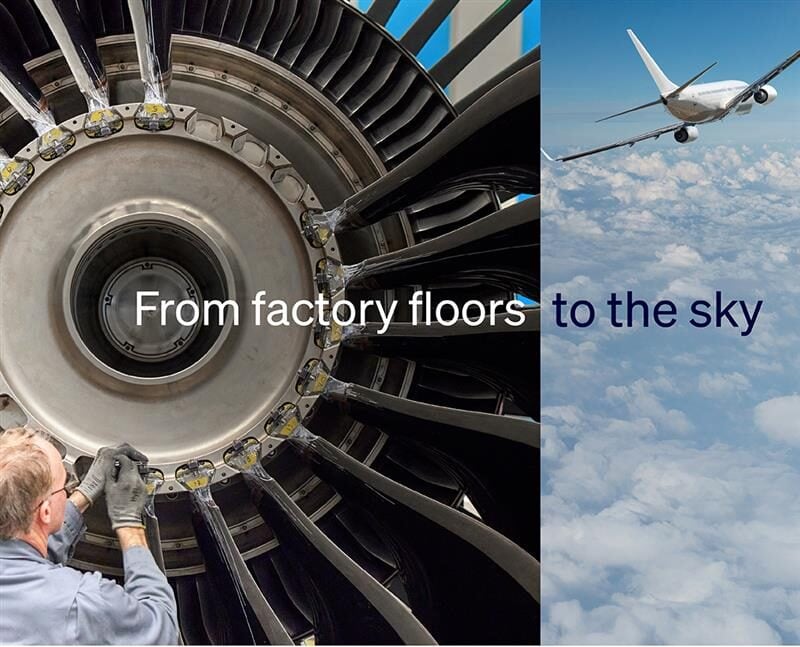
GE Aerospace plans to invest more than €110 million across its European manufacturing sites this year as it seeks to expand production capacity, accelerate advanced manufacturing and strengthen delivery performance for customers. The investment programme is accompanied by plans to recruit more than 1,000 new employees across Europe in 2026.
A substantial share of the investment will be directed towards state-of-the-art engine test cells, advanced machining equipment, the expansion of additive manufacturing, and upgrades to buildings and infrastructure. These enhancements will support a range of commercial narrowbody and widebody engine programmes, as well as military fighter jet and helicopter engines.
The investment will be distributed across five European countries, with €77 million allocated to Italy to enhance advanced manufacturing and testing capabilities across multiple commercial and defence engine programmes, including new and upgraded test cells, machining equipment, additive manufacturing expansion and site improvements. Poland will receive €15 million to support advanced grinding and machining equipment, welding and inspection tooling, and facility upgrades. In the Czech Republic, €8 million will be invested in precision machining and grinding systems, quality inspection technology, assembly tooling and infrastructure improvements. The United Kingdom will see €10 million invested in upgraded test and manufacturing equipment, expanded electronics and component manufacturing capabilities, and modernised facilities. Romania will receive €3 million for metal-cutting machines, tooling, fixtures and building upgrades.
In addition, GE Aerospace plans to invest approximately €40 million across its European maintenance, repair and overhaul (MRO) and component repair facilities this year, forming part of a previously announced global US$1 billion investment in MRO capabilities.
Alongside its manufacturing expansion, GE Aerospace is addressing the shortage of skilled labour in high-tech industries by investing in workforce development across Europe. This includes recruiting new talent and supporting both current manufacturing personnel and future engineers through training initiatives and grants to vocational schools in the UK and Italy, expected to reach more than 800 students this year. The company is also expanding its ‘Next Engineers’ programme in Warsaw, Poland, which is set to engage more than 4,000 students.