
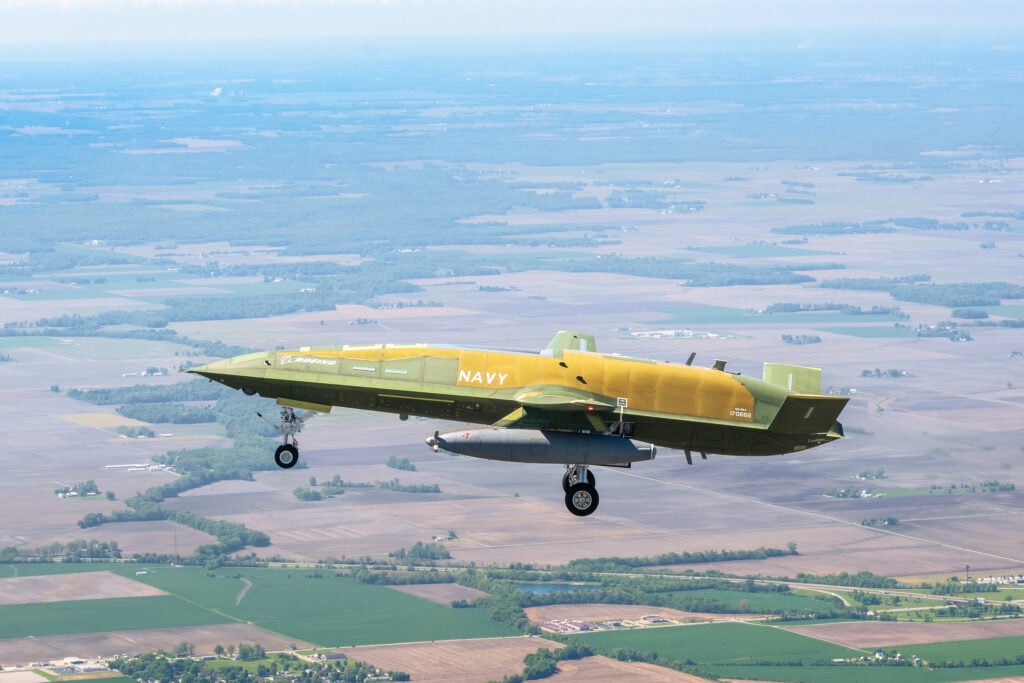
Boeing and the US Navy have successfully completed the first test flight of an operational MQ-25A Stingray™, marking an important step towards aircraft carrier deployment and signalling a new phase in naval aviation.
During the two-hour sortie, the unmanned aircraft demonstrated full autonomous capability, including taxiing, take-off, flight and landing, while responding to real-time commands from the Unmanned Carrier Aviation Mission Control System MD-5 Ground Control Station (GCS). Boeing and US Navy air vehicle pilots supported the मिशन by issuing commands and monitoring performance from the GCS at MidAmerica St. Louis Airport in Mascoutah, Illinois, where the programme is based. Once airborne, the Stingray executed a pre-planned mission profile, validating its flight controls, navigation systems and safe integration with the ground control infrastructure.
The MQ-25A is central to the Navy’s strategy for integrating unmanned systems on aircraft carriers, enabling effective manned–unmanned teaming. Its primary role as an autonomous aerial refuelling platform will extend the operational reach of the carrier air wing, while allowing F/A-18 Super Hornets—currently tasked with refuelling duties—to return to their core function as multi-role strike fighters.
This aircraft is the first of four Engineering Development Model units to be delivered under the original US$805 million Engineering and Manufacturing Development contract. Boeing and the US Navy will continue a series of test flights from MidAmerica St. Louis Airport to further validate system performance before relocating operations to Naval Air Station Patuxent River, Maryland, where preparations for carrier-based qualification trials will begin.