
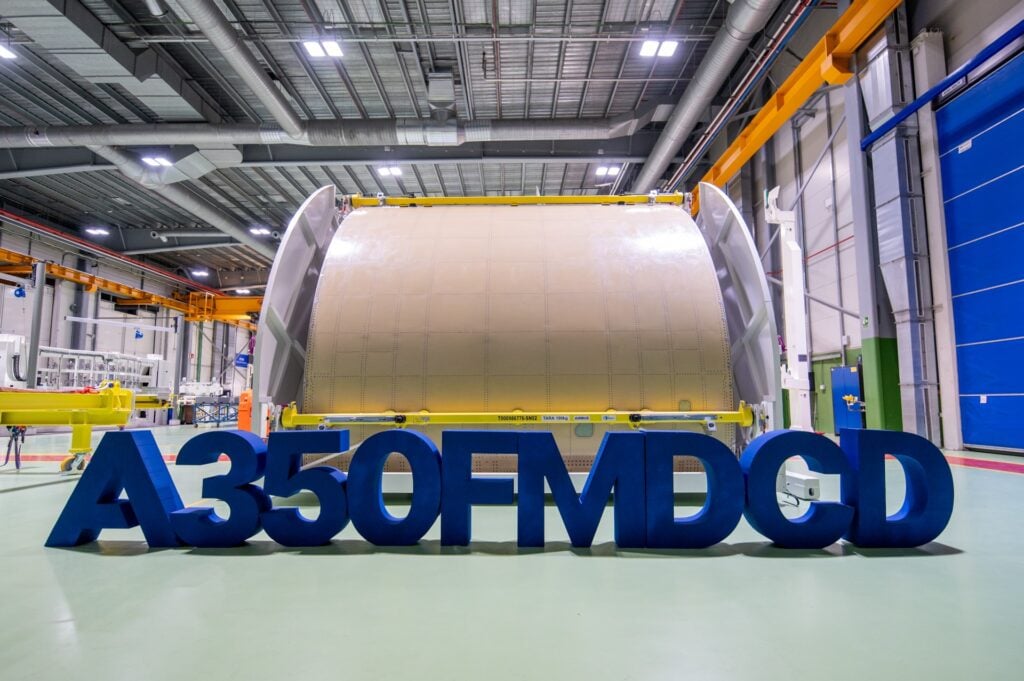
Airbus has completed the manufacture and assembly of the first main deck cargo door for its A350F freighter at its Illescas facility in Spain, marking a significant step forward in the programme’s development. The component has now been delivered to the final assembly line in Toulouse, where it will be integrated into the fuselage of the first test aircraft ahead of ground and flight testing scheduled between 2026 and 2027. Two A350F aircraft are being produced for this certification campaign.
The cargo door itself is a standout feature of the aircraft and the largest of its kind in the industry. With a cut-out width of 4.5 metres and a height of 4.3 metres, it is engineered to streamline cargo handling, enabling faster, safer and more efficient loading and unloading operations. Positioned in the rear fuselage to maintain an optimal centre of gravity during loading, the door is constructed from advanced composite materials and incorporates an electrically powered actuation system for opening and closing.
Illescas plays a central role in this process as one of Airbus’ key centres for large, complex composite structures. The site is responsible for producing the door’s structural skins and completing assembly before shipment. During the pre-series phase, these doors are installed in Toulouse; however, once serial production begins, integration responsibilities will shift to Hamburg, where the door will be fitted into the aft fuselage and equipped with its actuation systems before final transport to Toulouse.
The A350F is designed to meet evolving air freight requirements, offering a range of up to 8,700 kilometres and a payload capacity of 111 tonnes, making it well suited to long-haul operations. Built with more than 70% advanced materials, it is significantly lighter than competing aircraft, contributing to improved efficiency. Powered by Rolls-Royce Trent XWB-97 engines, the freighter is expected to deliver up to 20% lower fuel consumption and carbon emissions compared with previous-generation models. It is also the only freighter fully compliant with ICAO’s 2027 CO₂ standards and will be capable of operating with up to 50% sustainable aviation fuel at entry into service, with a roadmap to 100% capability by 2030.