
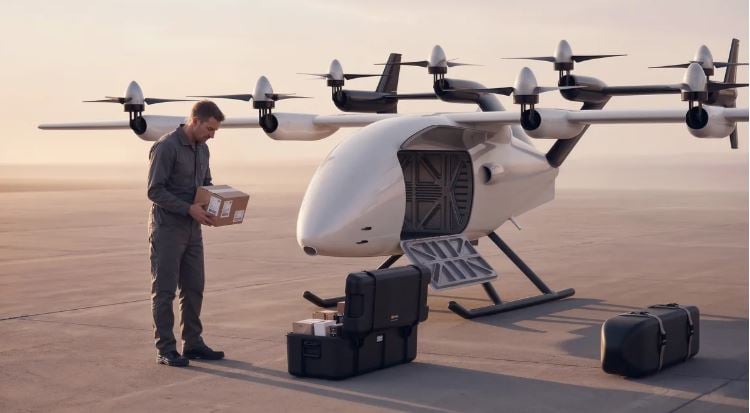
Zuri has unveiled its uncrewed cargo VTOL, a hybrid-electric tiltrotor designed for civil and defence operators. It can carry more than 100 kg over a design range of 679 km, or 569 km with a full 30-minute reserve. The aircraft also cruises at 220 km/h, lands on various surfaces and carries a useful load of 165 kg.
The aircraft builds on Technology Demonstrator 2.0, a full-scale prototype currently undergoing ground testing in Prague. The first €6 million tranche of Zuri’s Series A funding round will finance TD 2.0 and its full flight-test campaign, with €1.1 million committed by existing investors.
Since 2018, Zuri has flown more than 15 aircraft across hundreds of test flights and has demonstrated full-scale hover since 2021. Technology Demonstrator 2.0 integrates the complete architecture into a single full-scale aircraft and is currently undergoing systems integration and ground testing in Prague. Flight testing is scheduled to begin in early 2027, with the findings directly informing the uncrewed cargo aircraft. Six of the programme’s eight graded risks have already been retired. What remains is integration and flight testing, not invention.
Cargo is carried in a sealed bay within the airframe. An interchangeable pod beneath the aircraft can carry sensors, a communications relay or additional cargo, and can be swapped on the ground to suit each mission. Every flight is remotely piloted, with a ground-based operator in command and automation managing the aircraft in flight.
Distributed propulsion and redundant fly-by-wire systems ensure the aircraft remains controllable following the loss of a rotor, with no single point of failure. If the generator fails, the battery provides enough power to land. This delivers the redundancy sought by offshore regulations that require helicopters to have a second engine.