
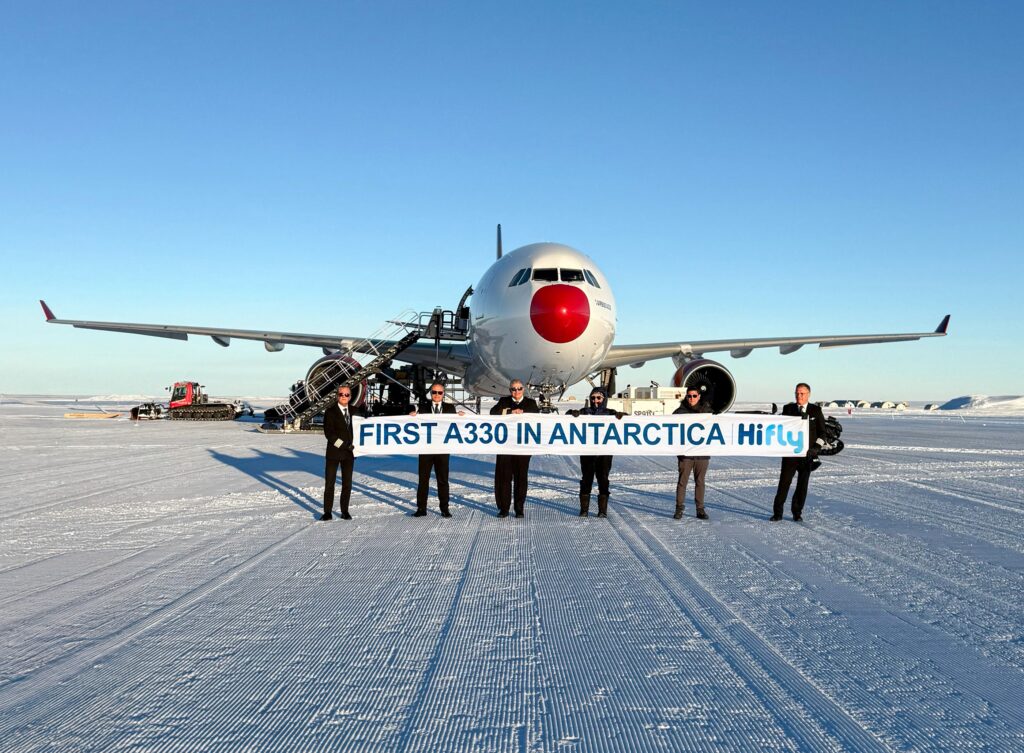
Hi Fly has achieved another landmark moment in polar aviation, successfully landing an Airbus A330 in Antarctica for the first time. The accomplishment comes just a month after the airline celebrated five consecutive years of operations to the White Continent.
The milestone flight took place on December 1, when Hi Fly’s Airbus A330-302, registered 9H-HFI and powered by General Electric engines, touched down on the blue-ice runway at Wolf’s Fang Runway at 11:59 p.m. local time. Commanded by Captain Carlos Mirpuri, Vice-Chairman of Hi Fly, the aircraft connected Cape Town, South Africa, with the remote Antarctic airfield as part of Hi Fly’s continuing partnership with White Desert Antarctica for the 2025/2026 season. On board for the occasion was Captain Antonios Efthymiou, Hi Fly’s CEO, who joined the mission to mark this significant achievement.
The A330, which shares the same fuselage as Hi Fly’s A340 but operates with two engines rather than four, offers comparable performance with improved fuel efficiency and reduced environmental impact. The introduction of additional ground support equipment at Wolf’s Fang has now enabled safe twin-engine operations—capability that was not available during Hi Fly’s early Antarctic missions. Renowned for its reliability, comfort, and strong safety record, the A330 has proven well suited to the extreme and unpredictable conditions of polar flying.
This latest success builds on Hi Fly’s historic 2021 breakthrough, when the airline became the first to land an Airbus A340 on the frozen continent. Bringing the A330 into service marks the beginning of a new chapter, combining sustainable performance with operational flexibility in a region where precision and environmental responsibility are paramount.
“Landing in Antarctica is never routine; every flight demands meticulous planning, exacting precision, and deep respect for the environment,” said Captain Mirpuri, who also commanded the first A340 mission. “Introducing the A330 to this remote runway showcases our commitment to innovation, operational excellence, and the continuing evolution of polar aviation.”