
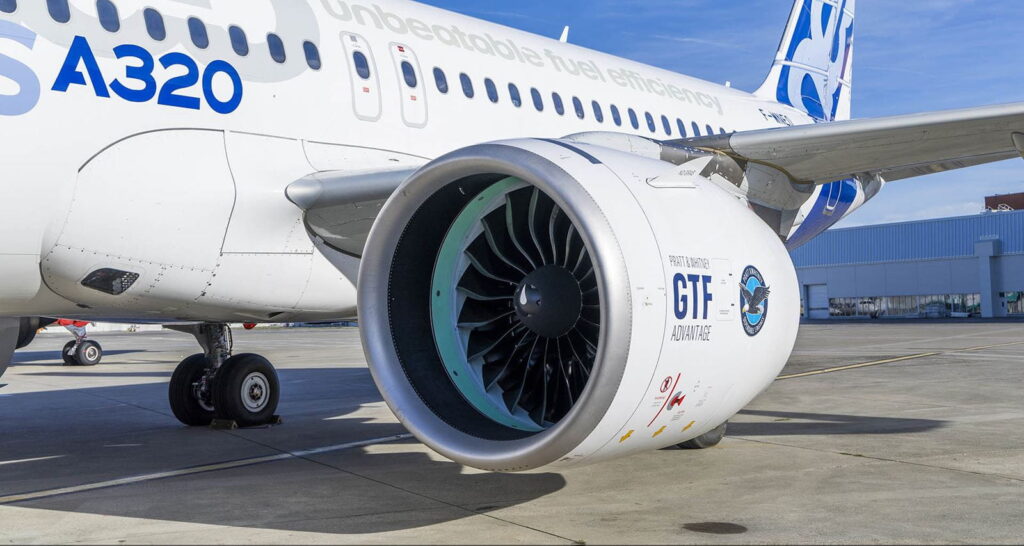
Pratt & Whitney has secured European certification for its GTF Advantage engine on the Airbus A320neo family, clearing a major regulatory hurdle ahead of entry into service. The European Union Aviation Safety Agency (EASA) approval follows earlier certification by the U.S. Federal Aviation Administration in February 2025 and subsequent validation by EASA in October 2025, paving the way for initial production deliveries.
The GTF Advantage builds on Pratt & Whitney’s geared turbofan architecture, which already offers leading fuel efficiency in the single-aisle segment. The upgraded variant is designed to extend that advantage, delivering improved durability and operational capability. According to the manufacturer, the engine can provide up to twice the time on wing compared with earlier GTF models, a key metric for airlines seeking to reduce maintenance frequency and maximise aircraft utilisation.
Performance enhancements are also central to the programme. The GTF Advantage is expected to deliver between four and eight percent more take-off thrust, enabling higher payload capacity and extended range. This combination allows operators to open new routes and improve economics on existing sectors. Crucially, the engine remains fully interchangeable and intermixable with the current GTF model, simplifying fleet integration. Pratt & Whitney plans for the GTF Advantage to become the production standard for the A320neo family, with full transition targeted by 2028.
For existing operators, the company is offering a pathway to capture much of the upgrade’s benefit without acquiring new engines. The GTF Hot Section Plus (HS+) package for the PW1100G-JM will allow airlines to achieve up to 90–95% of the durability improvements. This retrofit option is scheduled to become available later this year and can be installed during routine maintenance visits, limiting additional downtime.
To support anticipated demand, Pratt & Whitney is continuing to expand its industrial footprint. Investment includes nearly US$1 billion in its turbine airfoil facility in Asheville, North Carolina, and a further US$200 million in its forging facility in Columbus, Georgia, aimed at increasing overall production capacity and supporting the engine’s ramp-up.