

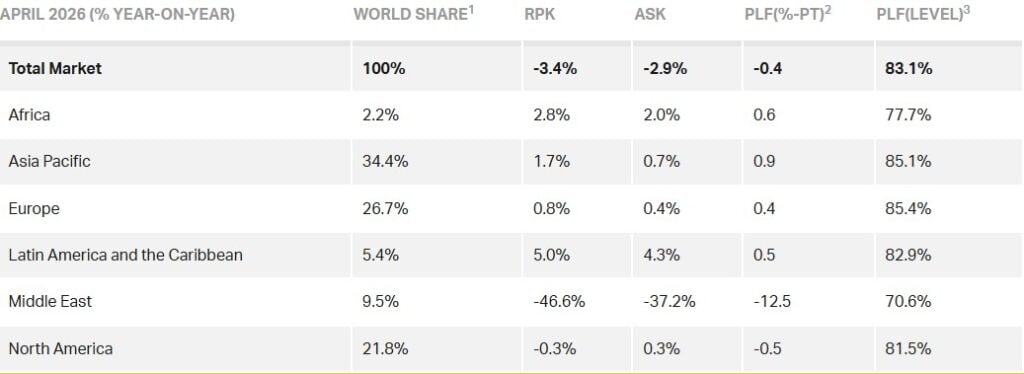
The International Air Transport Association (IATA) has reported a decline in global passenger demand for April 2026, as the ongoing conflict in the Middle East continued to disrupt international air travel and push up operating costs.
Total passenger demand, measured in revenue passenger kilometres (RPK), fell 3.4% compared with April 2025. Excluding the Middle East, however, demand rose by 1.2%. Capacity, measured in available seat kilometres (ASK), declined by 2.9% year-on-year, while the global load factor slipped 0.4 percentage points to 83.1%.
International traffic dropped 5.3% year-on-year, although demand increased 1.9% when Middle Eastern markets were excluded. Capacity fell by 5.1%, while the international load factor eased by 0.2 percentage points to 83.9%.
Domestic markets were broadly unchanged from a year earlier. Capacity increased by 0.8%, but the load factor declined by 0.7 percentage points to 81.9%.
“The 46.6% fall in demand for carriers in the Middle East due to war in the region was so acute that it dragged overall demand down 3.4%,” said Willie Walsh, IATA’s Director General. “The situation for air transport remains highly volatile. The cost of jet fuel more than doubled in April, which is pushing airfares up. Forward schedule data is showing a reduced offering in the coming months, indicating that airlines are balancing high fuel costs and weaker demand.”
International traffic performance varied significantly by region. Asia-Pacific airlines recorded a 3.0% increase in demand, while capacity rose by 0.7%. The region achieved a record April load factor of 87.5%, up 1.9 percentage points year-on-year, despite a slowdown on the Japan–China corridor linked to continuing political tensions.
European carriers posted a 0.9% rise in demand, supported by a 15.3% increase in direct traffic between Europe and Asia as passengers shifted away from routes transiting through the Middle East. Capacity grew by 0.3%, lifting the load factor to 84.9%.
North American airlines reported flat demand compared with April 2025. Capacity declined by 1.1%, helping raise the load factor by 0.9 percentage points to 83.9%.
Middle Eastern carriers remained the hardest hit, with demand plunging 48.1% year-on-year. Capacity fell by 38.4%, while the load factor dropped 13.1 percentage points to 70.1%. Although traffic continued to suffer from the impact of the Iran conflict, the pace of decline eased slightly following the implementation of a fragile ceasefire.
Latin American airlines delivered the strongest regional performance, with demand rising 8.9% and capacity increasing 7.2%. The load factor improved by 1.4 percentage points to 84.6%.
African carriers recorded a 2.2% increase in demand, supported by a 1.2% rise in capacity. The region’s load factor reached 77.9%, up 0.7 percentage points from a year earlier.
Across domestic markets, growth in Brazil, China and Japan offset weaker performances in Australia, India and the United States. Load factors declined in most major domestic markets, although China and Japan were notable exceptions. In Japan, capacity has now contracted for eight consecutive months.