
As we strive for ever more effective operating methods, will AI-assisted troubleshooting give us the edge the MRO sector needs to become not just more proactive but also more effective?
There is no substitute for experience, and nowhere is that more applicable than on the shop floor of an aircraft hangar where a commercial jetliner is undergoing routine maintenance. That said, some of the necessary experience is in a different area to hands-on physical work and is becoming more focused on data analysis. The reason? To predict when a part is likely to fail or need replacing as operating methods transition from being predominantly reactive in years gone by, to being far more proactive today.
The greatest advantages of proactive MRO systems are fewer costly unplanned AOG incidents, and the implementation of more streamlined and cost-effective maintenance programmes. So how do we see Artificial Intelligence (AI) as becoming a potential gamechanger in the MRO sector when massive steps have already been taken to improve predictability through the extensive use of onboard sensors? Well, with so many technological solutions today, they tend to bring with them a new set of problems.
Predictive and proactive maintenance relies on data and trends. While sensors can generate massive amounts of data, that data still has to be analysed to give it value. The results of that analysis have to then be compared to previous results to identify trends, and in turn, those trends have to be interpreted to establish at what point action needs to be taken. This is all very well and good, and it has worked well for some time, but the downside has been the need to deal with the constant generation of more and more data as a sensor-driven digital monitoring system becomes the norm.
However, the use of AI can also help with fault troubleshooting, an area of MRO which is notorious for the cause of so many faults not being immediately recognisable. Rather than adopting a ‘trial and error’ approach, especially when trying to fix intermittent faults, AI troubleshooting has the potential to identify ‘the most likely cause’ based on a wealth of data related to previous similar problems. The savings on time alone could be very substantial at a time when operating costs are so critical.
With the current trend to adopt and adapt AI to provide so many improvements in how businesses and systems function, data analysis has almost become its ‘bread and butter’ modus operandi. Thus, the arrival of AI to coincide with the deluge of sensor-generated data in aircraft would seem to be a potential marriage made in heaven.
Combined, AI and sensor-generated data have the potential to transform how we identify probable problem root causes, and improve our decision-making during troubleshooting activities. For airlines and MROs facing growing operational pressure, technician shortages, and increasing fleet complexity, AI-assisted troubleshooting could more than level the playing field.
Why Troubleshooting Is Becoming More Complex
Modern aircraft systems are interconnected in ways that were unimaginable only a generation ago. Aircraft such as the Airbus A350 and Boeing 787 Dreamliner rely heavily on integrated avionics, digital communication networks, and advanced software-controlled systems. While these technologies improve aircraft performance and efficiency, they also create new maintenance challenges.
A single fault can generate multiple warnings across different aircraft systems, making root cause identification difficult. Technicians frequently encounter intermittent faults that disappear before inspection or defects that cannot easily be replicated on the ground. In many cases, troubleshooting becomes a lengthy process involving repeated inspections, component replacements, and extensive system testing.
At the same time, maintenance organisations are under constant pressure to reduce aircraft downtime and improve turnaround times. Every additional hour spent troubleshooting affects operational schedules, maintenance costs, and fleet availability.
AI technologies are being developed specifically to address these challenges by helping technicians process and interpret complex maintenance data more efficiently.
What AI-Assisted Troubleshooting Means
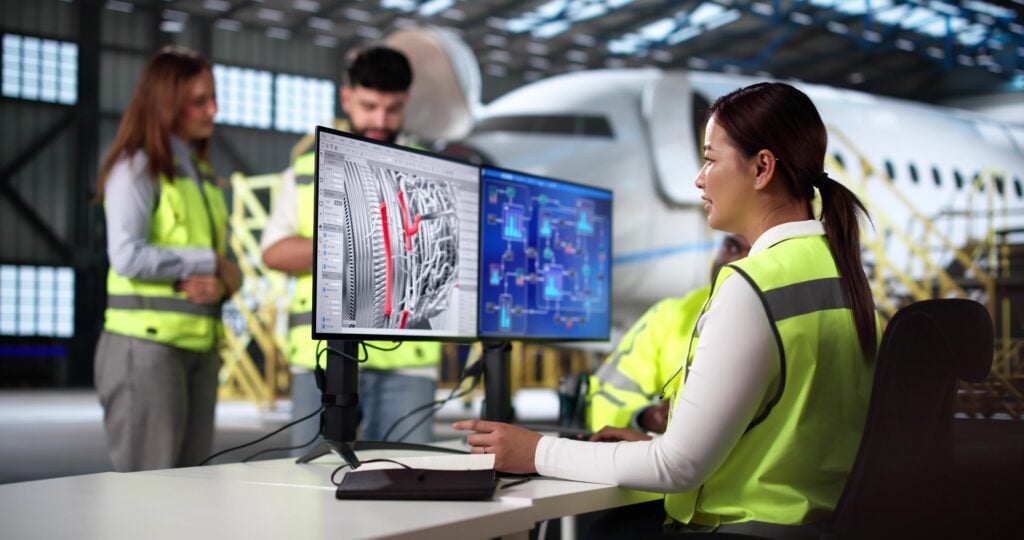
AI-assisted troubleshooting uses machine learning algorithms and large datasets to support maintenance personnel during fault diagnosis. These systems analyse information from aircraft sensors, maintenance histories, flight operations data, and previous repair records to identify patterns that may not be immediately visible to human technicians.
Instead of relying solely on static troubleshooting manuals, AI systems can dynamically compare current aircraft behaviour with thousands of historical maintenance events. Based on these comparisons, the system can recommend probable root causes, suggest optimised troubleshooting procedures, and even predict which components are most likely responsible for a fault.
The technology essentially acts as an intelligent diagnostic assistant that continuously learns from operational experience.
This approach represents a significant shift from reactive troubleshooting toward data-driven maintenance intelligence.
From Predictive Maintenance to Intelligent Diagnostics
AI-assisted troubleshooting is closely related to predictive maintenance, although the two concepts serve slightly different purposes.
Predictive maintenance focuses primarily on identifying early signs of component degradation before failures occur. By monitoring trends in vibration data, temperatures, pressures, or performance parameters, predictive systems help operators schedule maintenance proactively and avoid unscheduled events.
AI-assisted troubleshooting, by contrast, becomes active once a fault or anomaly has already occurred. Its objective is to accelerate diagnosis, improve fault isolation accuracy, and reduce unnecessary maintenance actions.
In practice, the two technologies increasingly work together. A predictive system may identify abnormal engine vibration trends, while the troubleshooting system helps technicians determine the exact source of the problem and recommends the most effective corrective action.
Applications in Modern Aircraft Maintenance
One of the most important applications of AI-assisted troubleshooting is engine diagnostics. Modern engines generate enormous amounts of health monitoring data during every flight. AI systems can analyse subtle performance deviations and identify early signs of wear or degradation long before conventional warning thresholds are exceeded. This allows maintenance teams to address issues proactively, reducing the risk of unscheduled engine removals and aircraft-on-ground events.
Avionics troubleshooting is another area where AI offers significant advantages. Intermittent avionics faults are notoriously difficult to diagnose because they may only appear under specific operational or environmental conditions. AI systems can correlate flight phases, environmental data, historical defect records, and system interactions to identify probable root causes more effectively than traditional troubleshooting methods.
Digital maintenance assistants are also becoming increasingly common within MRO organisations. These AI-powered systems allow technicians to interact with maintenance documentation in a more intuitive way. Instead of manually searching through extensive technical manuals, technicians can query systems conversationally and receive targeted troubleshooting guidance based on historical maintenance knowledge and aircraft-specific data.
Operational Benefits for Airlines and MROs
The operational benefits of AI-assisted troubleshooting are substantial. Faster fault diagnosis directly reduces aircraft downtime, improving fleet utilisation and operational efficiency. Even small reductions in troubleshooting time can generate major savings across large fleets.
Improved diagnostic accuracy also reduces unnecessary component replacements. In traditional troubleshooting, uncertain diagnoses sometimes lead to multiple component swaps before the actual fault is identified. AI systems help narrow down probable causes more effectively, reducing inventory consumption and maintenance costs.
Another important benefit is knowledge retention. Many airlines and MRO providers face the challenge of losing experienced technicians through retirement. AI systems can help preserve valuable troubleshooting expertise by learning from historical maintenance actions and making that knowledge accessible to newer technicians.
The technology also improves maintenance planning by helping organisations anticipate resource requirements, allocate labour more efficiently, and optimise spare parts positioning.
Challenges and Limitations
Despite its potential and as previously alluded to, AI-assisted troubleshooting also presents several challenges.
One of the biggest obstacles is data quality. AI systems depend heavily on accurate and consistent maintenance records. In reality, maintenance data often contains incomplete descriptions, inconsistent terminology, or human reporting errors. Poor-quality data can limit the effectiveness of AI algorithms and reduce trust in system recommendations.
Regulatory considerations also remain important. Aviation authorities require maintenance organisations to follow approved procedures and maintain clear accountability for airworthiness decisions. AI systems can support troubleshooting, but they cannot replace licensed personnel or approved maintenance processes.
Human acceptance is another critical factor. Technicians may initially hesitate to trust AI-generated recommendations, particularly if systems produce occasional inaccuracies. Successful implementation requires transparent system design, strong user training, and close involvement of maintenance personnel throughout deployment.
Cybersecurity is an additional concern as maintenance systems become more connected and data driven. Protecting maintenance data and aircraft health monitoring networks from unauthorised access or manipulation is becoming increasingly important in modern aviation operations.
The Continuing Role of Human Expertise
Although AI technologies are advancing rapidly, aircraft maintenance remains fundamentally dependent on human expertise. Technicians continue to play the central role in inspection, judgment, safety evaluation, and certification decisions.
AI systems can process data and identify patterns far more quickly than humans, but they lack practical experience, contextual understanding, and operational judgment. They cannot physically inspect aircraft structures, evaluate unusual conditions, or make final airworthiness decisions.
The future of aircraft maintenance is therefore unlikely to involve fully autonomous troubleshooting. Instead, the industry is moving toward collaborative intelligence, where technicians use AI tools to improve efficiency and decision-making while maintaining full responsibility for maintenance actions.
Looking Ahead
Over the next decade, AI-assisted troubleshooting is expected to become increasingly integrated into everyday maintenance operations. As aircraft systems become more complex and operational pressures continue to grow, maintenance organisations will need more advanced diagnostic capabilities to remain competitive.
Airlines and MRO providers that successfully integrate AI into their maintenance workflows may benefit from lower operational costs, faster turnaround times, improved reliability, and better fleet availability. However, technology alone will not determine success. Effective implementation will require high-quality data management, strong regulatory oversight, robust cybersecurity, and continued investment in technician training and development.
In conclusion, aircraft maintenance has always been about solving problems quickly, accurately, and safely. AI-assisted troubleshooting may soon become one of the industry’s most valuable tools in achieving that goal.