
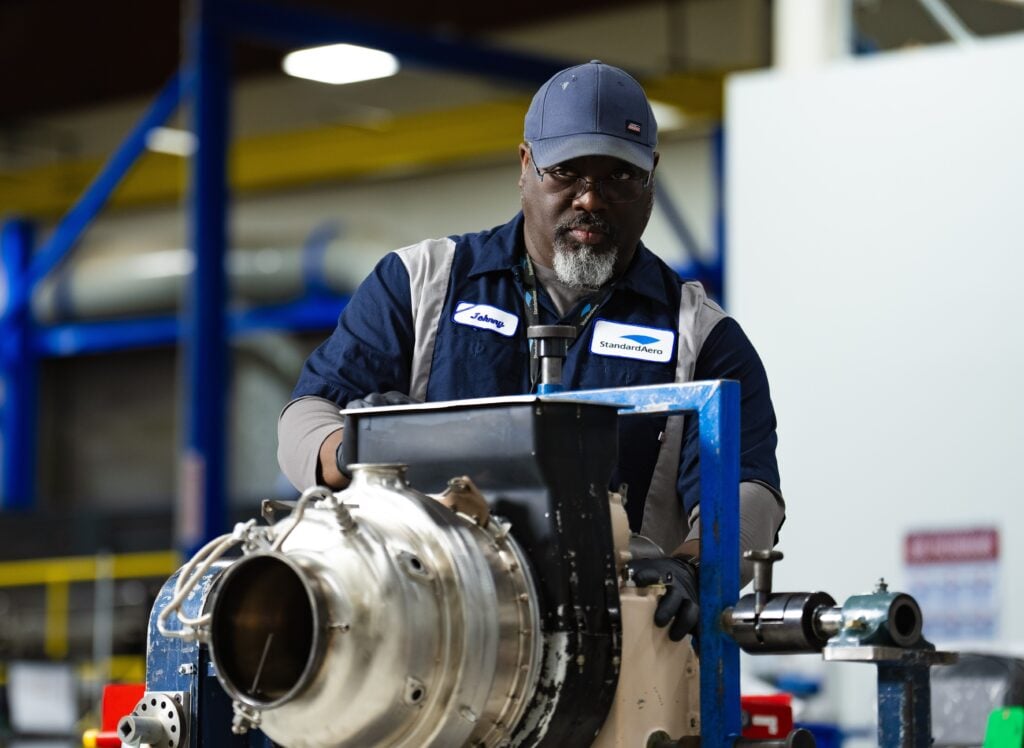
Hidden away in the tail of an aircraft, it is quite remarkable just what an Auxiliary Power Unit (APU) provides and what it can do in terms of an aircraft’s functionality. It is perhaps the use of the word ‘auxiliary’ that most likely undermines its perceived value and capabilities. From the moment the main engines shut down and in the absence of ground equipment, the APU becomes responsible for the provision of all electrical power for the likes of hydraulics and instrumentation through to cabin lighting, as well as air conditioning for optimum passenger and crew comfort. Of course, one mustn’t forget that the APU is also responsible for providing the power to restart the main engines from ‘cold’. In relation to the term ‘auxiliary’, the APU is more than capable of providing power throughout the aircraft in the event of total engine failure, but that when in flight, the APU literally becomes surplus, auxiliary to requirements and is switched off.
We wanted to lift the lid on just how much work is involved in maintaining APUs, so we spoke to five leading companies fully versant in all aspects of APU maintenance to get their take on this specific element of MRO operations.
How critical is the APU to day-to-day airline operations from a reliability and cost standpoint?
Because of its role when there is no ground equipment available, Vitalija Zutautaite, VP Trading at AerFin Ltd describes the APU as “fundamental” to day-to-day operations. She further explains: “If the APU becomes unserviceable, the aircraft is immediately subject to minimum equipment list restrictions, with defined time limits to restore serviceability. That creates operational pressure quickly. At worst, an APU failure can lead to delays or cancellations, with knock-on costs including passenger compensation depending on the regulatory environment. While APU maintenance costs are modest compared to main engines, the operational impact of failure is anything but.” Noelia Hernandez, Strategic Asset Manager at AJW Group uses the word “vital” to describe an APU, adding that “While the APU isn’t a propulsion engine, its failure creates significant operational disruption. When an APU goes down, airlines become dependent on ground support equipment like GPUs (Ground Power Units), which introduces costly delays and additional handling requirements, so a reliable APU is the foundation of smooth turnarounds for airlines. While typically turned off during flight, the APU is an emergency source of electrical power during flight. For example, if an aircraft lost both IDGs, the APU can be turned on to power avionics and is also an emergency back-up for pneumatic systems.”
The term chosen by Darran Brunton, Sales & Business Development Manager at EirTrade Aviation to describe the APU’s role is “a key component” in terms of airline operations. He expands on this by advising that “APUs are generally quite reliable as they are treated like mini engines with tracked TSN and CSN, and in most examples contain LLPs. Maintenance on APUs can get expensive, with variable lead times depending on findings at shop inspections, making forward planning key to minimise costs. Most airlines now will have hot spares or short-term lease options to cover these gaps.” He then adds that “From a reliability standpoint, the APU is a high cost, but standard system used across virtually all commercial airlines globally, though it is not strictly essential for dispatch as aircraft can operate under MEL (minimum equipment list) with ground support. However, because APUs can burn a lot of fuel when in operation, airlines generally try to limit their use on the ground to reduce costs, particularly fuel burn.” Meanwhile, Marcy Broadway, Interim Director of APU Programs at StandardAero finds the word “critical” appropriate when considering the need for an APU because, as she tells us, “The APU acts as a vital backup for electrical and hydraulic systems in case of main engine generator failures. While aircraft can fly without a functioning APU under the Minimum Equipment List (MEL), this does increase operating costs due to a reliance on external ground equipment. The APU itself is very reliable as long as all OEM maintenance guidelines are followed.
We finally have the use of the word “essential” coming from Quincey Pagani, Director of Sales – APU, at Werner Aero LLC. She succinctly points out that “If the APU is inoperative, airlines would have to be dependent on ground equipment, which could increase delays / cancellations, costs, and overall operational complexity. Unscheduled maintenance events can cause major schedule and cost impacts for operators.”
In what ways does APU performance impact overall aircraft turnaround and on-time performance?
As with most technology, the more complex and greater the number of parts, the greater the chance there is of something going wrong. While an APU may in many ways be indispensable where the functionality of an aircraft is concerned, we wanted to know when having an APU can also create additional challenges.
“APU performance has a direct impact on turnaround efficiency and on-time performance. A fully operational APU allows aircraft to operate independently during ground handling without having to wait for external (GPU) support,” says Noelia Hernandez, adding that “… any performance degradation, whether reduced electrical output or compromised bleed air pressure, extends start times and can lead to failed engine starts, which lengthens turnaround times. This is particularly relevant for short-haul operators, where tight scheduling means even minor delays can have significant operational and financial impact.” However, Darran Brunton has taken a more optimistic view of the situation, concentrating on the plus side of things. “APU performance accelerates TAT (turnaround times) by providing immediate onboard electrical power and bleed air, enabling rapid operation of aircraft systems. It supports operational autonomy, allowing crews to start engines and power systems without waiting for ground support equipment. APUs are generally highly reliable and offer flexible capability compared to ground-based support, although they are more expensive to operate in terms of fuel and maintenance. They also simplify and streamline pre-departure and turnaround procedures, helping aircraft maintain tight TAT schedules and reducing dependency on airport infrastructure availability,” he explains.
The APU provides essential electrical power and pneumatic air, used for air conditioning and main engine start, Marcy Broadway tells us, before pointing out the pros and cons of an APU: “A functioning APU enables airliners to ‘turn around’ faster, compared to aircraft lacking an APU (or with a non-functioning unit), which necessitates a reliance on ground equipment. An APU is already running when an aircraft arrives at the gate, and the main engines are shut down. By comparison, if the aircraft is reliant on an external power unit there will be extra steps – and time – required to get the aircraft running on ground power, resulting in deplaning delays and longer turnaround times. A running APU keeps tight turnaround schedules flowing!”. Quincey Pagani also sees the upside and downside of the APU, noting that as it provides so much support to operating systems when an aircraft is on the ground its functionality is directly related to aircraft turnaround and on-time performance.” She goes on to say that “When the APU is not operating reliably, the poor performance of the APU could cause delays in boarding or departure, which would negatively impact on-time performance for the operator. Another point is that when an operator experiences less-efficient aircraft turnarounds, it could increase fuel burn and emissions that would increase overall operating expenses. Maintenance issues are not the only things that are affected when an APU performance is less than optimal but also increases in ground-operating costs can result as well as impacting an operator’s flight schedule.”
Lastly, Vitalija Zutautaite points out just how problematic a non-functioning APU can be, commenting that: “APU performance has a direct impact on turnaround times and schedule reliability. A slow start or failure delays engine start and pushback, while poor bleed performance affects cabin conditioning – particularly critical in extreme climates where turnaround windows are tight. In airports with limited ground support equipment, the APU is often the only available solution. In those environments, a failure can quickly escalate into a significant delay or even a diversion. There’s also a supply challenge. APU removals are typically unplanned, and without spare units available, operators are forced into urgent sourcing – driving AOG exposure and additional cost.”
What are the typical maintenance intervals and shop visit drivers for APUs?
Every component on an aircraft requires regular checks and inspections, while those components with LLPs, such as an APU, present even greater challenges. How the subject of APU maintenance is approached would seem to be reasonably uniform where this article’s contributors are concerned, though some additions were of great interest. “APUs are included in scheduled maintenance checks (often within A-checks etc), where they undergo visual inspections and may include more detailed tasks such as borescope inspections. EGT margins are continuously monitored and drops in performance or starting capability can lead to APU removal for a shop visit. APU maintenance is generally ‘on-condition’, meaning there are no fixed overhaul dates. Maintenance and removal are driven by condition, performance, and life-limited part tracking. APUs remain in service until performance degrades i.e., reduced EGT margin, reliability issues or when LLP limits are reached,” Darran Brunton suggests. Marcy Broadway is primarily on LLPs as the principal driver for driving shop visits. “This depends on the APU type. The main shop visit drivers are for life limited parts (LLP) time expiration, with the APU’s life limits driving maintenance schedules. Any LLPs experiencing reliability issues – such as cracked discs or cracked and liberated blades – will result in higher-than-normal shop visit frequency (and repair costs)”, she says.
Like Marcy Broadway, Quincey Pagani is also focused on LLPs. “Depending on usage and typical operating conditions of the APU, most shop visits are typically around 5-7k hours of usage. However, maintenance intervals are typically driven by hours / cycles and the life remaining on the LLPs. The main scheduled drivers are hot-section wear, combustor and compressor deterioration, LRU condition, and LLP wear. For many APU models, some units can have a lighter repair work scope to restore the serviceability of the APU and then others will have a heavier shop visit that would involve a full disassembly of the APU, with LLP replacement based on wear or cycle limitation,” she advises. Noelia Hernandez reiterates Pagani’s recommendation over the number of usage hours between shop visits, though adds the codicil of the operating environment: “Aircraft operating in hot or harsh climates, for example, may experience more conservative intervals. New APUs often achieve longer initial intervals before their first shop visit, but subsequent removals tend to follow tighter cycles. Shop visits are primarily driven by performance deterioration, particularly hot section degradation, typically observed through reduced EGT margins and increased fuel burn, and scheduled events such as life-limited part (LLP) replacements.” Vitalija Zutautaite perhaps sums up the above comments very succinctly as she informs us: “APUs are largely maintained on an on-condition basis, with shop visit intervals typically ranging between 4,000 and 8,000 flight hours, depending on utilisation and operating environment. In addition to performance-driven removals, life-limited parts on certain platforms – such as the GTCP131-9A and -9B – can also dictate shop visits.”
What are the most common failure modes or drivers for unscheduled APU removals?
The failure of an APU is not as catastrophic as it may sound, providing the aircraft is flying to an airport with an available Ground Power Unit (GPU). In addition, while it can cause inconvenience and problems, an aircraft is still considered safe to fly without a functioning APU. What we wanted to know was root cause of APU failures and reasons for unplanned maintenance is.
Like several others, Darran Brunton at EirTrade Aviation was quick to identify the hot section of an APU as being a focal point of problems as it “… operates under high stress, making wear and damage relatively common.” He adds that “The main driver is EGT margin erosion, where internal wear reduces efficiency and leads to higher operating temperatures. Mechanical failures can also occur, particularly in the starter-generator and Fuel Control Unit (FCU). Other common issues include oil seal leaks, foreign object damage (FOD), and compressor blade erosion. Foreign material ingestion can be more likely when aircraft are idle or not properly stored.” Quincey Pagani at Werner Aero LLC is pretty much in lockstep with Brunton as she tells us that “Deterioration / wear and tear and external component failure are typically the main drivers for unscheduled removals where these drivers can cause the unit to be no longer serviceable. The most common unscheduled removal drivers can include hot-section wear, oil system issues, and common failures of the LRUs such as the starter, fuel control unit, or ECU. Unscheduled removals are generally one of the main cost drivers for operators within their APU maintenance programmes.”
Vitalija Zutautaite at AerFin Ltd, Noelia Hernandez at AJW Group and Marcy Broadway at StandardAero all provide similar variations on a theme with Zutautaite suggesting that “The most common triggers are fail-to-start events, performance deterioration linked to EGT margin loss, oil leaks, and component failures such as starter generators and bleed valves. External factors also play a role. Foreign object damage and harsh operating environments – particularly hot and high conditions – accelerate wear and increase removal rates.” Hernandez indicates that the removal of an APU is usually as a result of the loss of its “… functionality such as complete power loss or the inability to generate sufficient bleed air pressure for engine starts. The failures are often symptomatic of underlying factors like foreign object damage (FOD), oil system issues, or excessive vibration.” She then adds that “You might see progressive performance deterioration within the hot section through EGT margin erosion or reduced output performance. It is a reliable performance indicator, so it’s important to recognise it as a symptom of deterioration rather than a root cause. Other parameters captured by the ACMS data (via DMM downloads) or health monitoring system, such as IGV data and other control system metrics also provide valuable insight into the overall APU condition.” Broadway concludes by stating that much depends on the APU type, pointing out that “Most failures that we see are caused by operators exceeding the OEM’s recommended ‘soft time’ maintenance interval, resulting in blade or disk failures. The other major drivers for unscheduled removals are high exhaust gas turbine (EGT) temperatures, oil leaks or high oil consumption,” she says.
How has predictive or condition-based maintenance (CBM) changed APU maintenance planning?
While an APU failure won’t necessarily result in an AOG scenario, it still has the potential to cause problems. As with all aspects of aircraft maintenance, anything that can help foresee a potential problem has to be of benefit. So, what difference has predictive maintenance or CBM made?
According to Noelia Hernandez, “Predictive maintenance is rapidly becoming the industry standard. OEMs like Honeywell and Pratt & Whitney have developed their own monitoring systems, and some independent MRO providers are developing sophisticated condition-monitoring platforms. This shift enables operators to move from reactive, failure-driven maintenance to data-driven decision-making. By continuously tracking EGT trends, bleed air performance, oil consumption, and start times, operators can anticipate deterioration before it becomes critical, avoiding unscheduled removals and inflated repair costs. The result is not just improved reliability but a fundamental redesign of maintenance planning that eliminates unnecessary shop visits.” In addition, Darran Brunton is also one to mention ‘on condition’ when referring to APU maintenance. He explains that “Predictive maintenance has shifted APU planning from rigid schedules to more data-driven, on-condition strategies. This allows operators to maximise the utilisation of LLPs and keep units on wing until performance degradation is observed. By using sensor data and trend monitoring (e.g., EGT margin, start performance), airlines can anticipate failures in advance, reducing unscheduled removals and AOG events, while improving maintenance planning and resource allocation.”
“The use of predictive maintenance and CBM has led to a greater focus on data-driven maintenance planning, rather than removals based on calendar dates. The use of real-time data has allowed airlines and MROs to provide more accurate removal schedules, which helps to keep fleets flying longer while reducing the incidence of unscheduled removals. In addition to improving maintenance planning and removal schedule visibility, this proactive data-driven approach also allows airlines to identify potential issues in advance, before critical failures actually occur,” Marcy Broadway informs us, underlining what a difference the ability to be proactively reactive rather than solely reactive makes. Quincey Pagani and Vitalija Zutautaite are of a similar mind to Broadway in terms of being more proactive. Pagani explains that “Predictive or condition-based maintenance has changed APU maintenance planning by allowing operators to be more proactive on being able to predict maintenance issues early and overall reducing unexpected failures. Based on trend behaviour, utilising predicative maintenance can provide recommended actions before an operator experiences an unscheduled removal.” “Predictive and condition-based maintenance have shifted APU management from reactive to proactive. Operators now have access to real-time performance data, including EGT trends, oil parameters and start behaviour. That visibility allows issues to be identified earlier, reducing AOG risk and enabling more controlled maintenance planning. It also supports a move away from fixed intervals towards true on-condition maintenance – improving reliability while avoiding unnecessary shop visits. Increasingly, OEMs and MROs are supporting this with digital health monitoring solutions that can forecast maintenance requirements in advance,” Zutautaite concludes.
What strategies are airlines using to reduce APU-related maintenance costs?
While predictive maintenance may help to reduce unexpected APU problems and even failures, reducing the cost of any maintenance also has to be a priority. “Airlines can reduce APU-related maintenance costs by: limiting run time of the APU by utilising ground power which can reduce the amount of fuel used and slows down wear accumulation; using used serviceable material during shop visits or implementing exchange pool agreements to improve availability and reduce downtime; and adapting predicative maintenance mechanisms to help for better planning of maintenance events rather than waiting until an event becomes AOG,” Quincey Pagani suggests. Marcy Broadway on the other hand looks at a slightly different aspect of maintenance planning, and that is the use of data, because “Airlines are using a more proactive data-driven approach, which helps to avoid unnecessary removals and shop visits. The data-driven approach to removals also helps repair shops to more efficiently schedule induction slots, resulting in less down-time for APUs while they are in the shop. In addition, many airlines are working closely with MROs in order to help keep maintenance costs down, using serviceable or repaired components when possible to realise cost savings versus the use of new parts. Finally, many airlines are standardising their fleets and their maintenance practices when it comes to APUs and specialised maintenance training associated with them.”
Just-in-time maintenance certainly helps to avoid costly unscheduled APU removals as well as AOG incidents according to Darran Brunton. He further advises that “Maintenance teams may also perform compressor washes to help recover performance and improve EGT margin, extending time on wing (benefits vary by condition and environment). Additionally, many operators use power-by-the-hour (PBH) or leasing/exchange programmes to stabilise long-term costs and transfer overhaul risk to third-party providers.” “There is a dual approach at play here. Forward thinking airlines are optimising APU use while also refining maintenance strategies,” says Noelia Hernandez. “First, they’re minimising unnecessary APU operation by utilising ground power when available (GPU). They’re also partnering with independent MRO providers who deliver faster turnarounds and greater flexibility. Lastly, they’re strategically using serviceable (SVC) components with remaining life rather than using new parts. Access to extensive APU portfolios and flexible material support solutions, such as those offered by AJW, also play a key role in minimising downtime and managing maintenance costs. Together, these strategies enable airlines to balance maintenance spend with operational effectiveness, something that potentially gives them a competitive advantage in today’s margin-conscious environment.”
Airlines are taking a practical, multi-layered approach. Reducing APU run time is key – using ground power and pre-conditioned air wherever possible limits wear and extends time on wing, says Vitalija Zutautaite. She then explains further that “Commercial strategies also play a role. Power-by-the-hour agreements provide cost certainty and access to serviceable units, helping minimise downtime during maintenance events. There’s also a clear shift towards serviceable and overhauled material in place of new OEM parts, without compromising reliability. Underpinning all of this is better data. Proactive monitoring and condition-based maintenance allow operators to intervene early, avoiding secondary damage and costly repairs. The result is lower overall maintenance cost and more consistent operational performance.”